


Welcome back to Japan and the World! And a warm welcome to those of you who subscribed while the newsletter was on a break. I was finishing off a book - Barbarians - exploring the first century of contact between Japan and the western world, in the 15th and early 16th centuries. It’ll be out next year with Penguin, and I’ll post a preview to this newsletter.
The star players in Barbarians include Japan’s ‘Three Unifiers,’ who took their country from fragmentation to nationhood using a judicious mix of scheming, bloodshed, ninjas and more bloodshed.
Each man had a nickname. Oda Nobunaga was once the ‘great fool’: like many a teenager, his future potential wasn’t immediately obvious to those around him. But in the 1560s and 1570s, he carved out for himself an impressive chunk of central Honshū (Japan’s main island), including the capital Kyoto.
Toyotomi Hideyoshi was, to his one-time boss Nobunaga, ‘that bald rat.’ Others called him ‘monkey.’ When Nobunaga died suddenly in 1582, at the hands of one of Japan’s most infamous traitors - Akechi Mitsuhide - Hideyoshi seized the chance to pick up where Nobunaga had been forced to leave off. He became Japan’s virtual dictator, adding to lands inherited from Nobunaga the rest of Honshū and the islands of Kyūshū and Shikoku.
The third and final unifier came to be known as the ‘old badger.’ Tokugawa Ieyasu is remembered by history as a man of cunning and strategic patience, willing to play the very long game. He was ruthless when he had to be, but was never one to squander his energies, men and money in fights that were unnecessary or unwinnable.
By far my favourite portrayal of him is Hiroyuki Sanada in the role of ‘Lord Toranaga,’ in the FX series Shōgun - based on James Clavell’s 1975 historical novel of the same name. The silences. The calculating gaze…
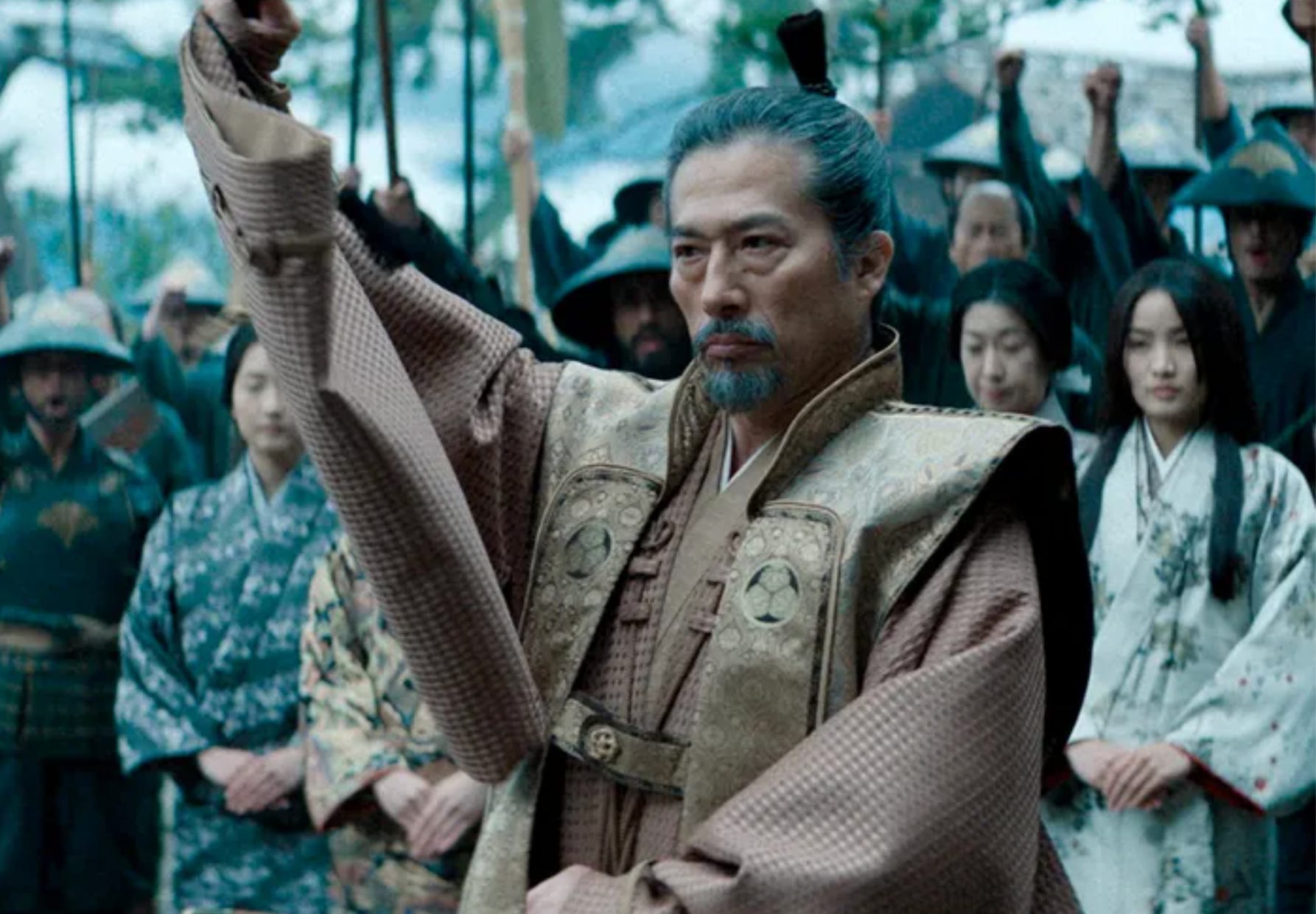
Hiroyuki Sanada as ‘Lord Toranaga’ in FX’s Shōgun
The real life and personality of Tokugawa Ieyasu is very difficult to reconstruct, since much of what we know comes to us from chronicles that were anything but neutral in their treatment of him.
But those ‘old badger’ traits really do come through in the decisions he made, across a long and extraordinary life. One story - possibly legendary - encapsulates those traits. Having made an alliance with Oda Nobunaga in the early 1560s, a young Ieyasu was steadily consolidating his power in and around a modest fief in Mikawa, central Honshū. One day, Nobunaga sent him a basket of peaches as a gift. Ieyasu’s men were no doubt looking forward to getting stuck in. But Ieyasu launched into a sermon:
This fruit may be a rare delicacy, but Nobunaga’s territory is far larger than mine. The things we can enjoy must be in proportion. If people like me take to wanting rare things, there will be only loss and no advantage. It would only mean planting good rice land with useless [fruit] trees, and giving the men more work.
In the same way, keeping fancy animals means wasting good money in getting and looking after them, while a taste for curios means frittering away your focus on worthless playthings…
He may not have been much fun at a party, but Ieyasu’s instincts served him well. When Nobunaga died, he calculated that he was not yet strong enough to make himself the successor. Out fighting in the field when the news about Nobunaga came through, Ieyasu decided to retreat to Mikawa to consider his options.
This wasn’t a very noble move, when set against Hideyoshi’s heroic act of vengeance against Akechi Mitsuhide. One of Ieyasu’s later chroniclers had, it seems, to concoct a face-saving account of what happened and why. Ieyasu, they claim, had wanted to go to the place where Nobunaga had died and take his own life - accompanying his lord into the other world. But his men had held him back, begging him not to leave them.
An uneasy truce was later made with Hideyoshi, and in 1590 we find the two men striking a bargain - reputedly solemnised by urinating, side by side, off a high castle wall. Ieyasu would receive an enormous fief in the eastern part of Honshū. Hideyoshi would remain hegemon.
The result was a few quiet and unromantic years for Ieyasu, during which he built up his castle-town at Edo. The castle itself was a leaky, near-derelict mess when he inherited it. The small surrounding town was built near a swamp. But rather than wasting his resources challenging Hideyoshi, Ieyasu held back while his great rival launched disastrous wars in Korea, weakening in the process many of the powerful lords (daimyō) who were compelled to participate.
By the time of Hideyoshi’s death in 1598, Ieyasu had the largest fief in the country, many years’ worth of vital administrative experience, and a very healthy treasury. After a few months of plotting and scheming, he managed to engineer an epoch-making battle between warlords loyal to him - the ‘Eastern Army’ - and lords loyal to Hideyoshi’s son and intended heir Hideyori: the ‘Western Army.’
Even now, Ieyasu was not prepared to take chances. He bribed one of the commanders of the Western Army to come over to his side once fighting commenced, as it did in the autumn of 1600. What became known as the Battle of Sekigahara helped to turn the ‘old badger’ into the shōgun in 1603: technically subordinate to - and working for - the Emperor, but in reality lord of all Japan. A century later, his little town with its leaky shack of a castle had become, some say, the largest city on Earth. It was later renamed ‘Tokyo.’
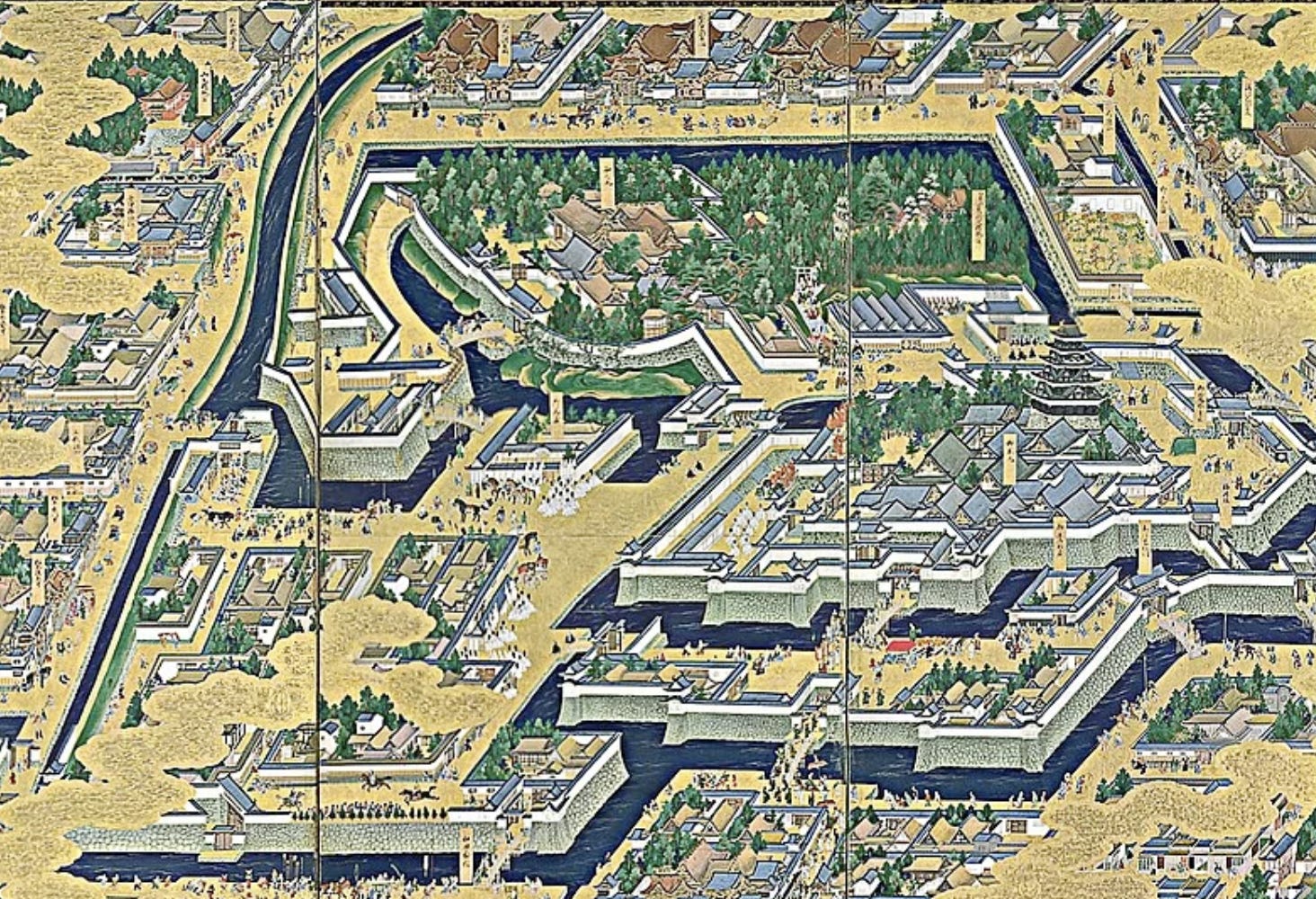
Edo Castle and its surrounds in the 17th century, following some home improvements by Tokugawa Ieyasu
Ieyasu brought his trademark strategic patience to his relationships with Japan’s western visitors - at least at first. He hosted visitors from Spain, Portugal, Holland and England, hoping to boost trade and turn Japan into a seaborne power capable of sending merchants everywhere from South-East Asia to Spanish-controlled Mexico. There was still much to be learned from Europeans, Ieyasu knew, about navigation, silver-mining and ship-building.
For a few years, this worked. Japanese ships travelled under a ‘red-seal’ system to Macao, Manila and elsewhere in Asia. The seal served as a guarantee that they were backed by the shōgun: they weren’t pirates, and they should be treated well wherever they went - on pain of reprisals.
In time, ships like these might have been seen regularly traversing the Pacific. But it wasn’t to be. The great obstacle, in a word, was trust.
Ieyasu was a Buddhist, who made use of Confucian thought in planning Japan’s future. He wasn’t particularly opposed to Christianity, which he most likely regarded - at least early on in his life - as a new teaching from India, linked to Buddhism.
But rumours persisted that the Spanish were planning to colonise Japan, using Japanese Christian converts either to create diversionary unrest or actually to fight on their side. After the Dutch and the English arrived in Japan - in 1609 and 1613, respectively - Portuguese and Spanish emissaries always placed the expulsion of the hated Protestants somewhere near the top of their diplomatic wish-lists. The Dutch and the English, for their parts, whispered into Ieyasu’s ear about the nefarious designs of the ‘papists.’
No less worrying for Ieyasu was the conversion to Christianity of close aides, some of whom turned out to be traitors. And when he began introducing restrictions on Christianity, the real nature of converts’ loyalties was exposed. It was bad enough that Christians worshipped a long-dead man who appeared to have been a criminal, lawfully executed by the authorities. But when Ieyasu had cause to burn a few Christians at the stake, under his own lawful authority, other Christians turned out to watch. They sang songs, cheered them on, and collected ‘relics’ at the end from their charred remains.
A man who had spent decades biding his time, building his base and planning Japan’s future in intricate detail now faced the prospect that after his death, this foreign cultural force - with ultimate loyalties pointing towards Europe - might undo everything he had striven to accomplish.
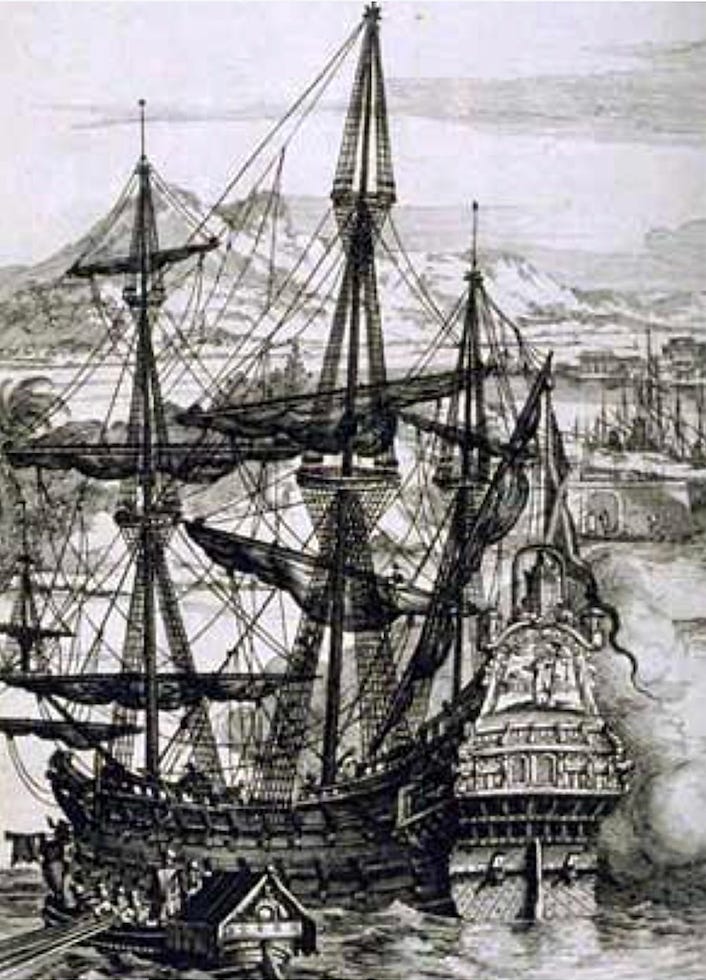
A Spanish galleon: the kind of ship that Ieyasu wanted his carpenters to learn to construct
By the standards of his time, Ieyasu wasn’t cruel. But he was decisive. In the four years leading up to his death in 1616, he clamped down ever harder on Christianity, paving the way under his successors for a full ban on Christian evangelism and worship - and on all westerners entering Japan, bar the Dutch, who were confined to the tiny island of Dejima in Nagasaki Bay. No Japanese were permitted to leave the country, on pain of execution if and when they returned.
Had he lived longer, Ieyasu might have found a less drastic solution to this problem of trust. Japan might yet have emerged as Asia’s paramount seaborne trading and military power. Instead, by the end of the 1630s, his successors had fully implemented a policy that came to known as sakoku: ‘closed country.’
But only in retrospect does all this seem like a missed opportunity. Put yourself in Ieyasu’s sandals, having at last seen an end to decades of civil war, and having managed to secure the title of shōgun for himself and then his son. Japan’s warlords had been brought to heel, and prosperity was returning. Why risk all that for the sake of a little overseas trade and good relationships with bickering Europeans?
If the final price of unification in Japan was clamping down on Europeans and their religion, then the Old Badger and his descendants were more than willing to pay it. Ieyasu’s reward was the passing of the title of shōgun not just to his son but onwards through another thirteen members of his extended family - across an extraordinary 264 years of Tokugawa rule. How’s that for playing the long game…?
*
Thank you for reading! Back next week at the same time. Meanwhile, if you’re enjoying the newsletter, please feel free to share this essay. Comments and questions are also very welcome!
—
Images
Lord Toranaga: Smithsonian (fair use).
Edo Castle and its surrounds: World History (fair use).
Spanish galleon: Wikipedia (public domain).

A few years ago, I saw a wonderful exhibition with handwritten prayers by Tokugawa Ieyasu and an amazingly lifelike statue.
Here is a link that shows a bit of it:
“Honen preached that by honoring Namu Amida Butsu, everyone can be equally saved and reborn in the Pure Land of Paradise. His teachings were supported by many people, from aristocrats to commoners, and have been passed down unbroken to the present day. This exhibition focuses on a number of famous treasures related to the Jodo sect, covering the period from its founding to its great development with the adoption of the Tokugawa shogunate.”
http://www.premium-j.jp/en/events/20240327_36283/?gt_lang=en
As for relevant exhibitions on the Three Unifiers, mention can also be made of the current exhibition at Osaka Castle. Handwritten letters and decrees by all three, swords, armour, replica of Hideyoshi's tea room and much more. Link to the exhibition:
https://www.osakacastle.net/exhibition/standing/detail.html?id=182