


Welcome back to the newsletter! Part of our Easter break was spent in southern Ireland, introducing my daughters to their Irish heritage via a journey around the famous Ring of Kerry.
Outside the car: the moody, romantic wash of the Atlantic against sun-dappled cliffs and headlands. Inside: a fight to the death, pitting The Beatles alongside the 1990s (indisputably British music’s crowning decade) against the nonsense that my daughters enjoy.
In amongst that nonsense, something interesting: a trend for girlbands based in South Korea to feature one or more Japanese members, with song lyrics mixing Korean, Japanese and English. If you want to impress your friends/children/grandchildren with the details, two of the biggest bands are Ive and Le Sserafim.
More interesting than the commercial dynamics underlying this precision-tooled pop is the effect that it’s having on the relationship between the two countries. It wasn’t that long ago that young Koreans would grow up learning to detest and distrust Japan, with stories handed down and told around family tables about Japanese colonial rule in Korea, from 1910 to 1945.
Working against that have been the popularity of Japanese pop and manga in Korea, and of Korean drama in Japan. So many female Japanese viewers fell in love with Korean masculinity – allegedly more sensitive and attentive than its traditional Japanese counterpart – that a group of Japanese men once protested outside the offices of a television broadcaster. They claimed that having watched Korean dramas, their wives now expected too much of them.
The story of what mixed-nationality, multi-cultural girlbands are contributing to this steady softening of relations between Korea and Japan is a fascinating one for another time. Here I want to explore a lesser-known source of antagonism between the two countries: the legendary samurai warlord Hideyoshi Toyotomi.
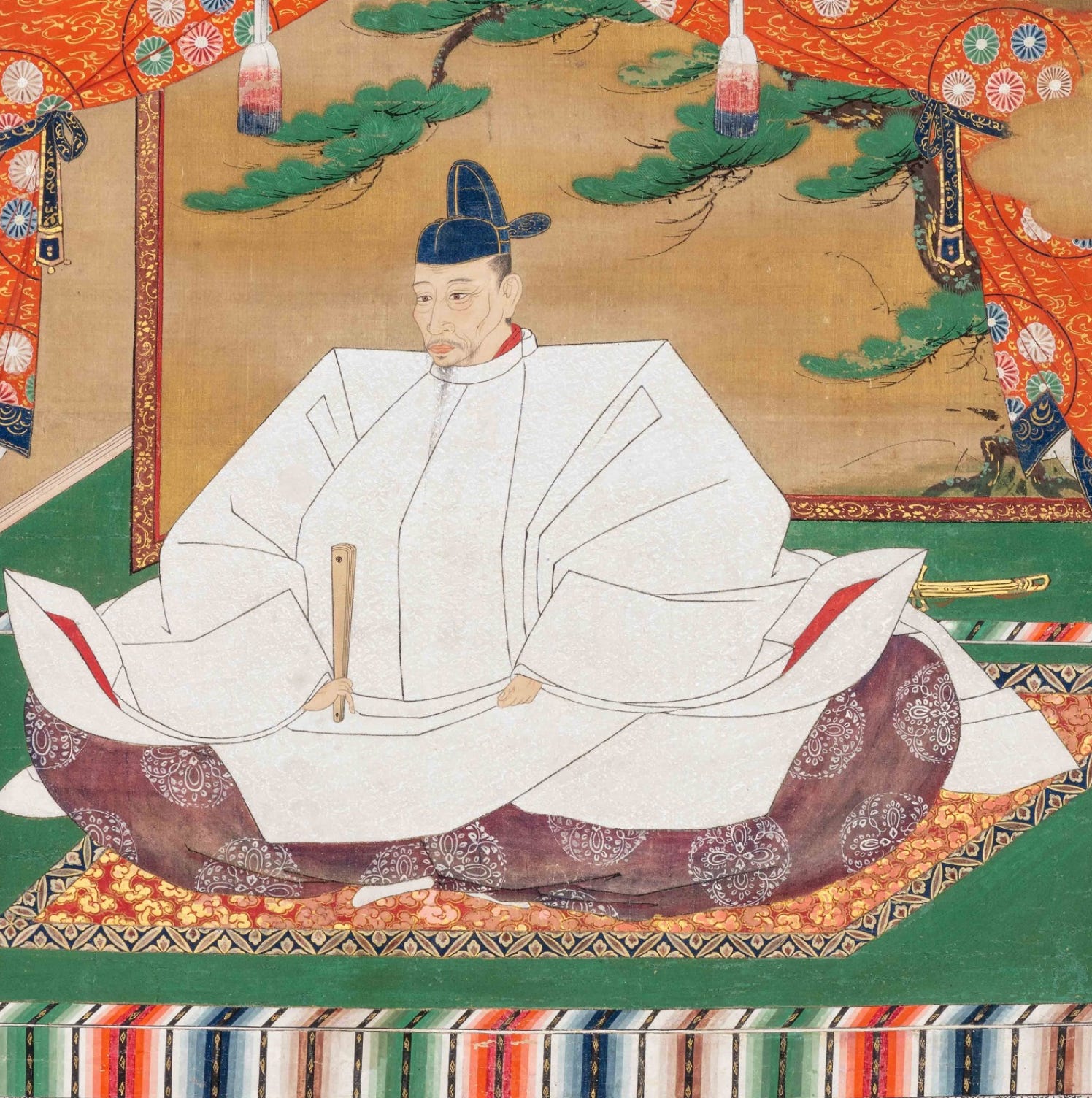
In the first essay in this series on Japan’s ‘three unifiers’ and the western world, we met Oda Nobunaga. Hideyoshi was his sandal-carrier, later a trusted general and finally Nobunaga’s avenger and successor. He also launched not one but two full-scale invasions of Korea in the 1590s, helping to sour relations ever since.
Born into a peasant family in 1537, and rising through the ranks of Oda Nobunaga’s army, Hideyoshi moved quickly to claim his lord’s mantle after Nobunaga’s death in 1582. He did away with the traitorous Akechi Mitsuhide and then used a combination of threats, bribes and violence to bring potential competitors to heel. Ending up in control of most of Honshū, Japan’s main island, he conquered Kyūshū in the late 1580s and began to look for bigger prizes further afield.
Hideyoshi by now possessed – or at least projected – an extraordinary sense of his own importance and destiny, as a man born in a peasant hut who had become the virtual dictator of a newly-reunited Japan. Some around Hideyoshi must have baulked when he claimed that on the night of his conception, his mother dreamed that rays from the sun entered her womb: an augury of a son who would one day illuminate the world. Hideyoshi also commissioned and starred in Noh plays about his greatest accomplishments - then forced Japan’s elites to sit and watch.
Oda Nobunaga’s attitude to the Europeans in his midst, mostly Portuguese traders and Jesuit missionaries, had been governed by questions of security. If they could help supply wealth and weapons for his unifying cause, while helping him battle Buddhist influence in Japan, then they were welcome. Hideyoshi was different. If he could fit Europeans into his grand scheme for global recognition, then he was happy to do business with them. If they failed to recognise or support his greatness, they were in trouble.
Trouble is what they got. Having taken control of Kyūshū, Hideyoshi discovered that a local warlord had granted the Jesuits ownership of the port of Nagasaki. They were turning it into a highly lucrative Asian entrepôt, inviting Portuguese merchants to do business there as part of the India-China-Japan trade route.
One of the missionaries bragged to Hideyoshi that the Jesuits could help him secure his grip on Kyūshū by interceding for him with some of the island’s Christian warlords. Later, in a sequence of events whose details are disputed even now, Hideyoshi gained the impression that the missionaries might be softening Japan up for an invasion by Spanish forces – launched, perhaps, from the Spanish-controlled Philippines.
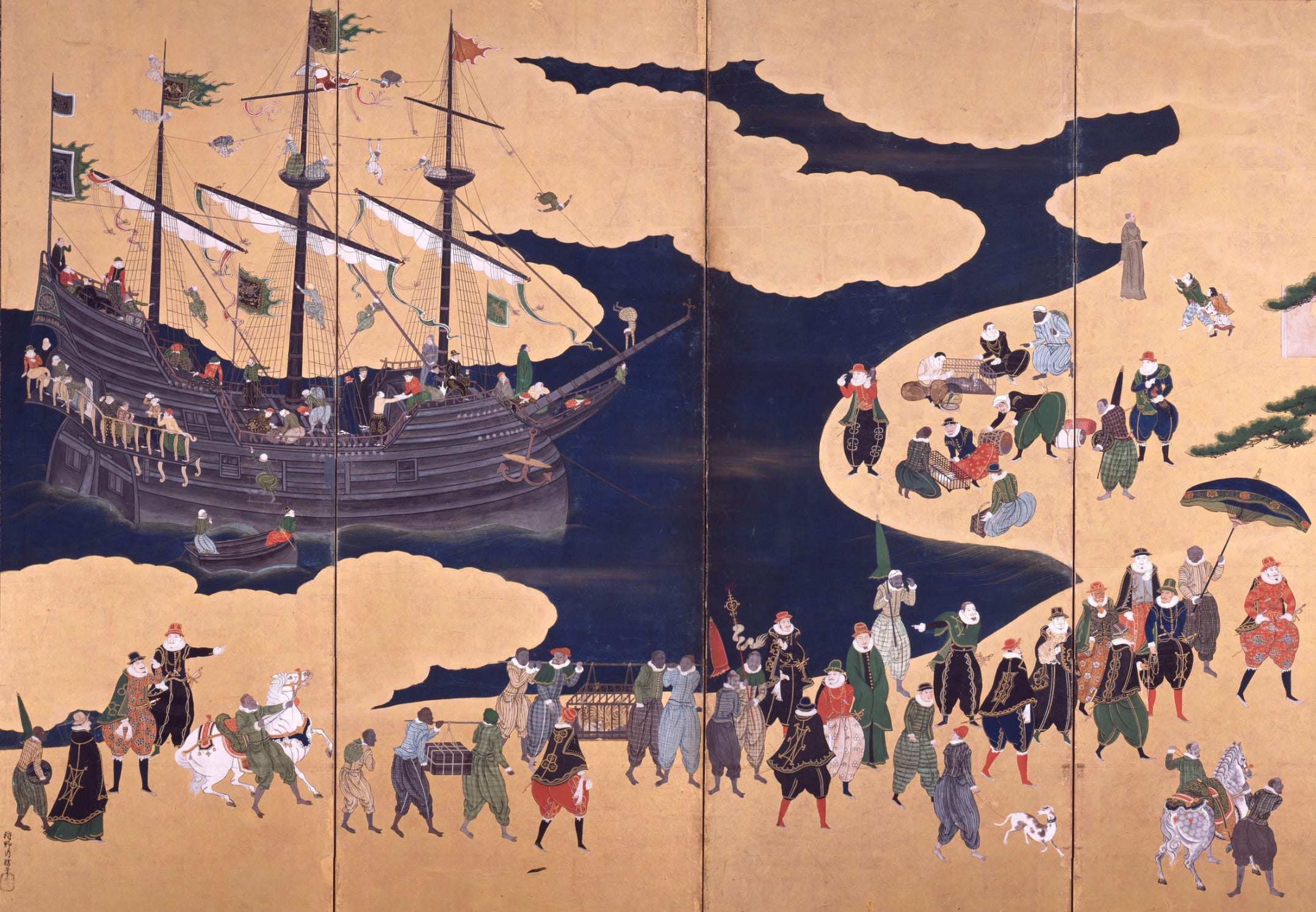
Detail from a screen painting of a Portuguese ship arriving in Japan
Hideyoshi’s response to all this was to clamp down on Christianity, as a foreign religion offensive to Japan’s kami. He had twenty-six Christians – a mixture of Japanese and Europeans – crucified at Nagasaki in 1597, as a demonstration of his displeasure.
Japan’s overlord was not against Europeans or European culture in general. He enjoyed, on occasion, dressing in what became known as ‘southern barbarian’ (nanban) style. This included baggy breeches, fancy hats, tight jackets, and rosaries and reliquaries worn about the body. One of his outbursts against Christianity is said to have been fuelled by a few glasses of good Portuguese wine.
But in his dealings with Europe, Hideyoshi expected respect – a great deal of it, grovelingly expressed. In his letters, he referred to Japan as the ‘Land of the Gods’ and was fond of rehearsing his mythical origins and status as the country’s saviour. A missive sent to the Spanish governor in Manila gives a flavour of his diplomatic style:
The Lord of Heaven has willed that the country be united in my time, and that it be reduced to my obedience. In accomplishing this, everything was so favourable to me, that as yet I have lost no battle, but have been victorious in every one for ten years.
Even from Eastern India embassies have been sent to me… I am much surprised that [the Philippines] has not sent me an ambassador or messenger… If an ambassador is not sent, I shall unfurl my banner and send an army against that country to conquer it with a multitude of men; so that it will repent.
Hideyoshi also wrote to the King of Korea: in a similar tone, but with a different demand. Hideyoshi planned, he said, to conquer China. Geography being what it was, he needed to use the Korean peninsula as a through-route. He assumed that the king would be happy enough about this, having already expressed due deference to Hideyoshi – a claim which must have mystified the king.
The Korean king’s failure to give Hideyoshi what he wanted resulted in the massing of samurai in Kyūshū in 1592, ready to sail across to Busan in Korea and either negotiate passage to China or punish the country for its insolence.
It was the largest seaborne deployment of troops to another country in history, up to this point: some 150,000 men. It was also an unusually multi-cultural endeavour. Some of the most trusted Japanese commanders bore names like Dom Agostinho Konishi and Dom Sancho Ōmura: samurai converts to Christianity, thanks to whom the first known European to set foot in Korea did so in 1593: as chaplain to Konishi.
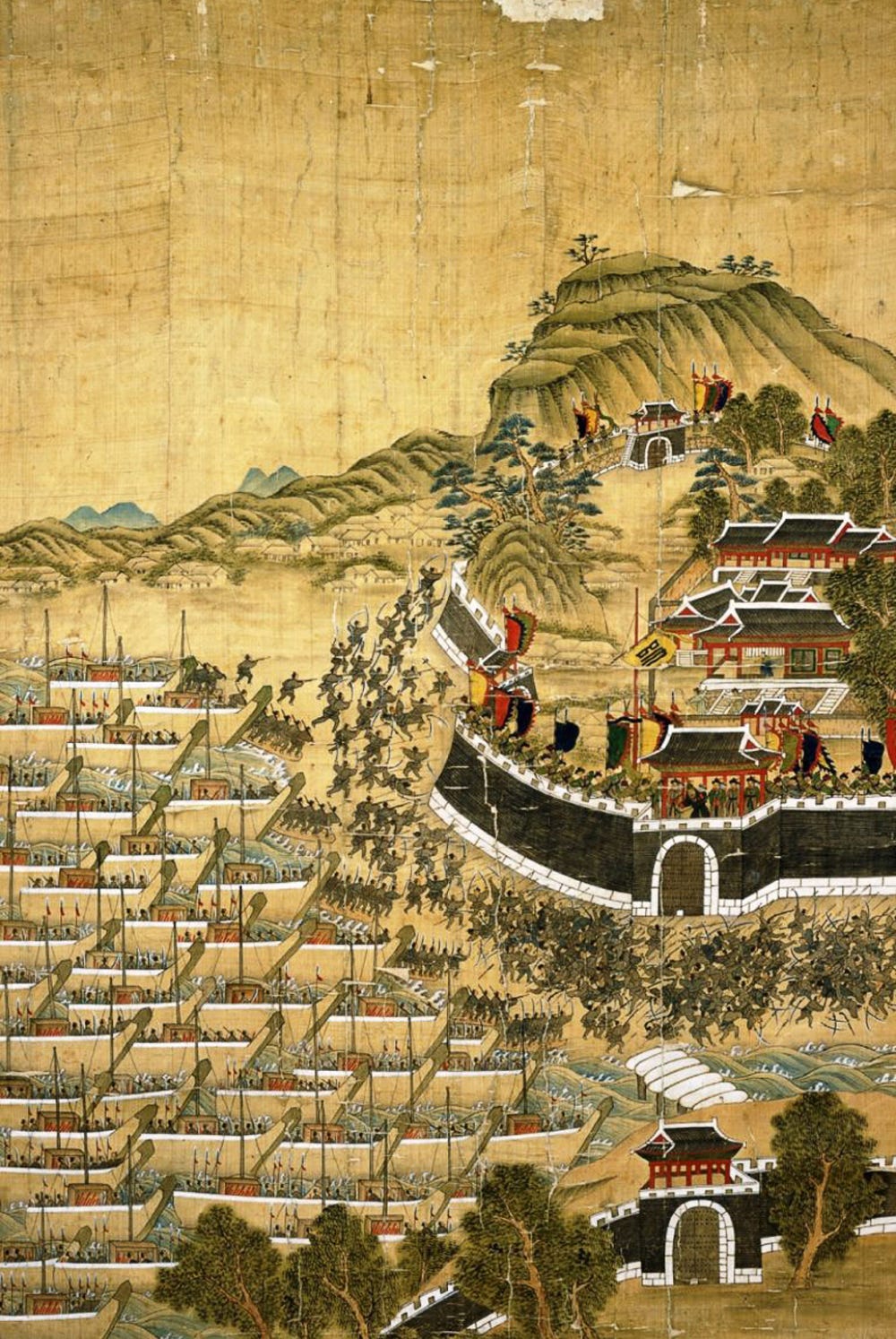
The siege of Busan Castle
Hideyoshi’s men fought their way up the peninsula before Chinese troops and the Korean navy forced them back. A second invasion fared no better. Generations of Koreans would remember a disastrous few years for their country, as many hundreds of thousands of people perished in what is known as the Imjin War. The idea remained vivid in Korean minds for centuries that the Japanese saw their country as inferior, and as a natural part of their own sphere of influence – a view of Japan dramatically reinforced in the twentieth century.
Europeans regarded the scale of the devastation in Korea with horror, while at the same time hoping that Hideyoshi’s covetous interest in the world beyond his borders – he even talked about invading India – might be open, in time, to cultivation. He loved the wealth that came from international trade, he was a fan of exotic clothes and destinations, and he enjoyed lording it over foreign leaders. Might he be persuaded to regard Christianity as central to this global culture – handmaiden, even, to future success?
Sadly, for those who harboured such aspirations – but happily, for the people of Korea – Hideyoshi’s destiny did not extend beyond the 1590s. Across the summer of 1598, his health began to fail, and he was soon confined to bed. His favourite European, a Jesuit interpreter named Rodrigues, tried to interest him in the prospect of Christian salvation. But a man who had mused on the possibility of taking ‘New God of War’ as his posthumous name was never likely to be receptive.
Hideyoshi died, entirely unrepentant, on 18th September 1598. He left behind a death poem, whose meaning has been mulled ever since. Was it a final thespian flourish – a performance, rather than a sincere reflection? Or had Hideyoshi turned the dial of self-aggrandisement so far that he had ended up back at humility?
Ah! As the dew I fall
As the dew I vanish;
Even Osaka Castle
Is a dream
Within a dream.
—
Thank you for reading! If you enjoyed this post, please like and share.
If you have thoughts on Japan and Korea, either now or in the past, please feel free to leave a comment.
And lastly, if you have access to BBC iPlayer, I was a guest on a couple of episodes of Michael Portillo’s Great Japanese Railway Journeys last week. We were in Kyoto and Nara.
I read this with great interest. What especially fascinated me was the perspective on how the Jesuits viewed Hideyoshi.
I serve as a Shinto priest in Osaka. The shrine where I work was revered by Hideyoshi, who designated it as a protector against the northeast “demon gate” of Osaka Castle. That connection was what first drew me to your post, but once I began reading, I found it so interesting that I read all the way to the end in one sitting.
On a lighter note, my daughter is also very fond of Korean idols, and I myself love the Korean drama Crash Landing on You. We even enjoy using Korean cosmetics together.
Hi Chris-sensei!
Thank you so much for such an interesting read, as always. I had no idea Hideyoshi even had his eyes set on the Philippines… This only adds to the many delusions and antics he exhibited after uniting Japan (especially after "fathering" Hideyori), as he really did seem to have gone completely bonkers — something not uncommon, if history teaches us anything, for people who suddenly find themselves with absolute power.
I wanted to write because I visited South Korea a few weeks ago for the first time while working on a cruise ship for a two-week "cherry blossom tour" of Japan. It was essentially a visa run for the ship, as foreign-flagged passenger vessels (apparently) cannot stay in Japanese waters for more than one consecutive week. Busan was part of the itinerary, of course, but I think it was chosen simply because of its proximity to Japan.
Anyway, for the guests, the day in Korea was a complete break from the Japan theme — perhaps intentionally, for the reasons you mentioned in your article — so they visited the hip and arty Gamcheon Culture Village (sold as "the Santorini of South Korea"), lunch at a local market, and a visit to an observation tower. Such a fun day — how could that go wrong?
I, being a Japanese student of history, and since I had a day off in Korea, I took the opportunity to explore Busan’s historical significance in the relationship between the two countries. As you know, Busan was where Japanese forces first established a beachhead during the Imjin War. And with that in mind, I visited the Joseon Tongsinsa History Museum, built on the site where the Korean goodwill missions’ envoys prayed for a safe voyage before crossing the Tsushima Strait to Japan. The narrative of the museum offered such an uplifting story of rapprochement and diplomatic triumph of Ieyasu after Hideyoshi’s death and the end of the war. FYI, numerous documents on Joseon Tongsinsa (or Chōsen Tsūshinshi in Japanese) in both countries are registered as a Memory of the World by UNESCO.
While the Tongsinsa Museum was roughly the size of a slightly large house, the contrast could not have been clearer with the nearby National Memorial Museum of Forced Mobilization under Japanese Occupation, which is a huge and daunting modernist building with ample bus parking spaces (primarily for school trips, I presume). I was struck not only by the obvious difference in tone, but more so by its scale. It's also worth noting that documents relating to forced mobilisation, on the other hand, are NOT registered as a UNESCO Memory of the World, despite repeated attempts by the Korean government due to fierce opposition from its Japanese counterpart.
The juxtaposition of these two museums made for a thought-provoking reflection on how history is remembered and presented on both sides of the strait, and I found myself thinking about it again after reading your article!
Sorry — I’ve definitely written far more than I probably should have here, but there was no word limit, so I took the liberty of babbling on. Apologies, but you know me, sensei! ;)