


Japan today passed a law intended to shore up its shaky line of succession. That line currently consists of just three men, and one of them is 90 years old.
How have they done it? By making it possible for men from branches of the imperial family that were cut off after World War II to rejoin. They themselves will not be eligible to become Emperor - but their sons will.
How haven’t they done it? By allowing women to ascend the Chrysanthemum Throne. That hugely popular change to Japan’s imperial arrangements remains as elusive as ever.
In this week’s post, I’m going to let you decide how this should go. I can’t guarantee to change Japanese law, but I can offer you some Substack democracy. I’ll give you what I think is the strongest version of each side, and then invite you to vote at the end.
Please share this post as widely as you can, and let’s get a decent vote going!
NO - Japan should not allow female emperors
Japan has had an unbroken male-line succession for at least 1,500 years - and up to 2,600 years, depending on how far back you think the imperial line goes, before history shades into myth. A male-line imperial succession is Japan. There can be no getting rid of it.
What has, after all, been the primary role of the Emperor across all those long years? Shinto’s high priest: a profoundly sacred role - performing rituals for the sake of the nation - which has always been associated with male lineage and ritual purity.
You don’t need to believe, as people once did, that the imperial line is divinely descended to recognise something precious and remarkable here. Why tamper with it?
And especially why tamper with it just because of international pressure? Many European monarchies have equalised their succession arrangements between men and women. That’s fine for them - it doesn’t mean Japan must do the same.
Nor should Japan be bullied by progressive opinion, whether at home or abroad. The imperial family ought to lie beyond public sentiment, as it always has. We’re talking about the deepest of divine mysteries, and the soul of an old and noble nation. It’s not a gameshow.
This pressure for a female emperor is part of a bigger attempt to cut Japan off from its past, which began with the Allied Occupation of Japan after World War II. The United States followed up its military victory with an assault on Japanese culture, from the removal of the Emperor’s power and the insistence on pacifism to new rules on family life that upset the old household system of the past.
Liberal commentators in the West who complain about sexism in Japan’s imperial arrangements miss something important: this isn’t, ultimately, about whether Princess Aiko - the only child of the current Emperor, and a popular figure in Japan - should one day become Empress. Japan has had female Empresses before. The problem would come with her children, if she had any: there would be pressure for them to succeed her, thereby bringing male-only succession to an end.
Advocates for gender equality in Japan should look elsewhere for meaningful wins: in politics, in Japan’s business culture, in the way women are portrayed in the media, in the sorts of expectations with which girls and boys are raised. Address all these things, and leave this ancient institution alone.
YES - Japan should absolutely allow female emperors
Under Japan’s constitution, the role of the emperor is to serve as a symbol of Japan and of the unity of its people. In a country which regularly features near the bottom of the rankings in the World Economic Forum’s Global Gender Gap report - and the lowest in the G7 - what kind of message does it send that women are barred from the throne?
Look at that same constitution, and you’ll discover that Japan is a democracy. And what do people want, on this issue? By overwhelming majorities - often reaching percentages in the 80s and beyond - they want women to be permitted to become Emperor, and they want a line of succession that can pass through women.
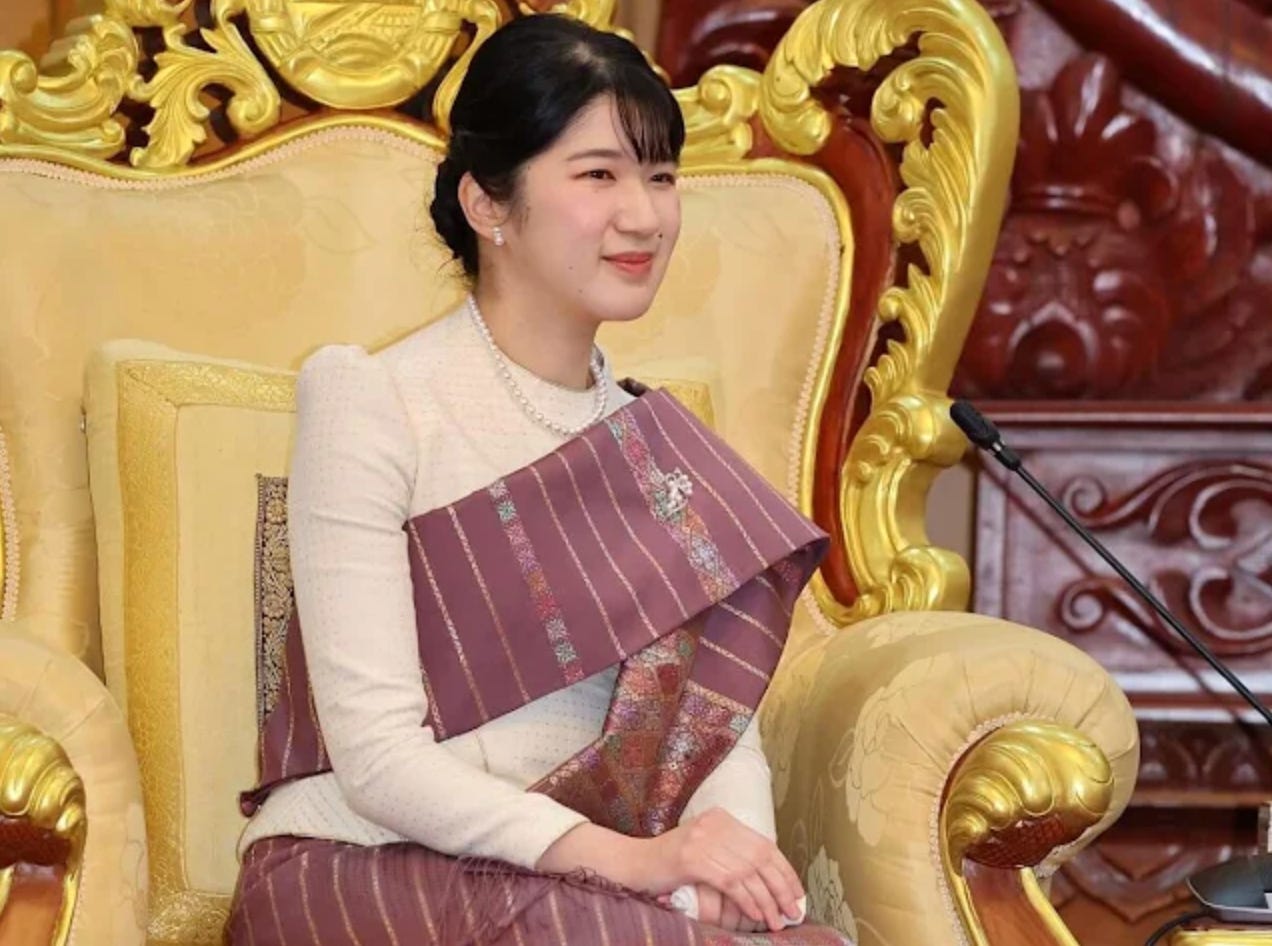
At a time when young people in Japan, especially, are feeling disengaged from the monarchy, changing the law to this effect seems like an obvious measure - an easy win. Princess Aiko has gained plaudits for her work with the Japanese Red Cross, including an overseas visit to Laos last year (pictured above). Why can’t she be allowed to do this kind of work as Empress? Japan’s monarchy would gain an immediate boost, at home and around the world, with Aiko-sama one day at the helm.
Under these circumstances, ‘because tradition’ seems a very weak argument. Look at how this tradition was established and sustained, and you find ancient ideas about women’s bodies being impure or their minds so second-rate that they are legally incompetent.
Making this change would not mean doing away with tradition. Little or nothing else about the role of the Emperor/Empress, and their position in Japanese society and culture, would need to be altered.
The point about traditions is that they endure. If the conservative establishment truly want the imperial institution to survive, they need to equip it to do so. That means ensuring the succession by broadening the pool of candidates to include women - by themselves, today’s measures are at best a sticking plaster. It also means clearing up a manifest injustice, of which the people of Japan are acutely aware and on which they have made their feelings plain.
There we are! Over to you:
If No/Yes feels a bit limiting, or you want to add to the case for either side, please feel free to comment.
And please share/re-stack, if you think others might like to get involved!
Image:
Princess Aiko in Laos: New My Royals (fair use).
Readers need to be reminded that Japan has had 8 empresses in its history, the most recent being Empress G-Sakuramachi (1762-1771). Shogun Hidetada's granddaughter was Empress Meisho. No historical reason not to have another.
Why have an emperor/empress at all? If we have to be anachronistic and preposterous, let's remember that the Japanese imperial family claims descent from the celestial sun goddess, Amaterasu, so let a woman be the new empress. I rest my case.