


During the World Cup this year, the familiar, heart-warming story about Japanese fans once again did the rounds - only this time with a twist.
There they were, diligently clearing up their rubbish before leaving the stands. But while global audiences sighed with approval, back in Japan women took to social media with variations of the same complaint: you do this in public, but at home you’re a slob.
It looked like double-standards. But I think it was something slightly different: the behaviour expected of people in public versus the relative freedom they enjoy behind closed doors.
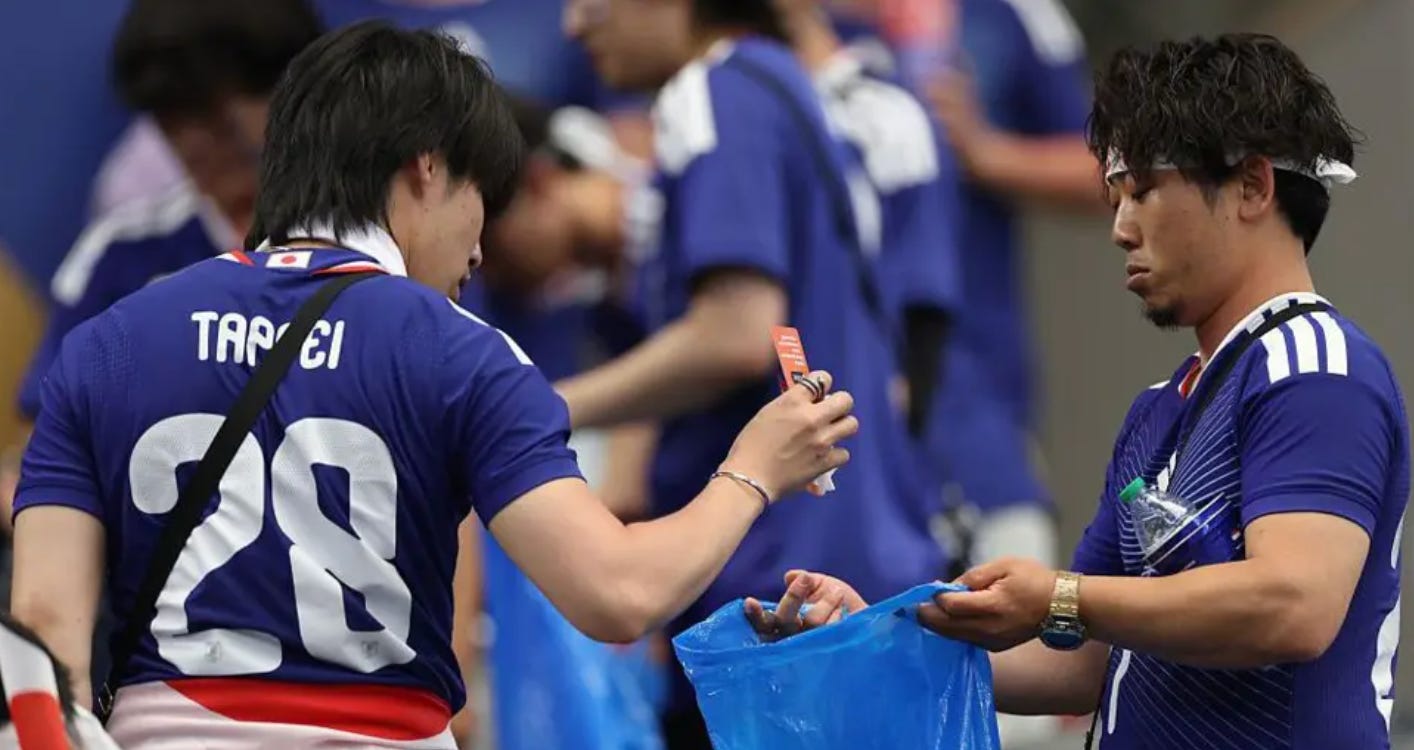
Those high public standards are one of the reasons why the ever-increasing number of western tourists flocking to Japan return home again asking themselves why in their own country they can’t have what the Japanese enjoy.
Less litter, less graffiti, less hassle on the street. Everything from transport to shopping working smoothly, and all of it lifted by a sense of people looking out for one another.
All this has become baked into our image of Japan - but why?
Partly it’s culture. From Shintō, you get cleanliness and respect. From Buddhism, compassion and an instinct for holding your self lightly. From Confucianism, respect again - especially for parents and social superiors.
And yet postwar Japan is famously non-religious. So it isn’t that these ideas in their raw, religious form naturally compel a great many people. It’s more that Japan has funnelled those ideas into a way of bringing up children that shapes them into the kind of people who are - for the most part, anyway - unlikely to relate to the world around them by mugging, stealing or defacing.
This used to be described in America and Europe as ‘conformism’ - thereby flattering a free-wheeling West. I’ve always found that a bit negative and reductive, and reading Lisa Katayama’s fascinating new book The Japanese Way of Parenting confirms it. She’s a writer and executive living in Northern California, raising her two young daughters the way she was raised: Japanese-style.
The core of it, for Lisa - in her book and in an interview for this essay - is the concept of omotenashi. Many readers will know it from time spent in Japan: a wholehearted hospitality, offered selflessly and in which nothing is too much trouble. It has roots of a kind in the tea ceremony.
For Lisa, omotenashi runs broader still. She defines it as ‘radically caring for everyone and everything around you’ - a beautiful, ambitious idea, which becomes practical and precise when you have your first child. It can boil down, she tells me, to simple things like ‘is our space habitably clean… [are there] healthy and timely snacks’ available?
A lot of this is about active anticipation of someone else’s needs. Sure, it’s lovely to ask a friend, partner or child what you can do for them. But it’s sometimes even better to work out the answer yourself and make the arrangements without troubling the other person with a question.
Just ask my wife, who often preferred her mother’s help over mine in the weeks after our first child was born. Her Mum’s experience of parenting was a big part of this, of course. But she was also well-versed in omotenashi. I’d be constantly asking an exhausted new mother what she needed, or what we ought to be doing next for the baby. Her own mother would meanwhile be several steps ahead, knowing what was needed and getting on with it.
As any parent knows, home is only half the story. The other half is nursery and school - how these places are run, and who your precious offspring might encounter there.
If omotenashi is the big, overarching value, the practical route to it in education is shūdan seikatsu: immersion in the art of ‘group living’, or ‘collective life’.
Lisa and her husband managed to find a Japanese daycare centre near where they live. Lisa’s daughter learned how to co-operate with other children in everything from cleaning their classroom and tidying away toys by category to pounding mochi for making rice cakes and looking after someone when they’re not having a good day.
As Lisa points out in her book, Japanese daycare centres and schools are as much about learning how to relate to other people as about picking up the basics of literacy and numeracy.
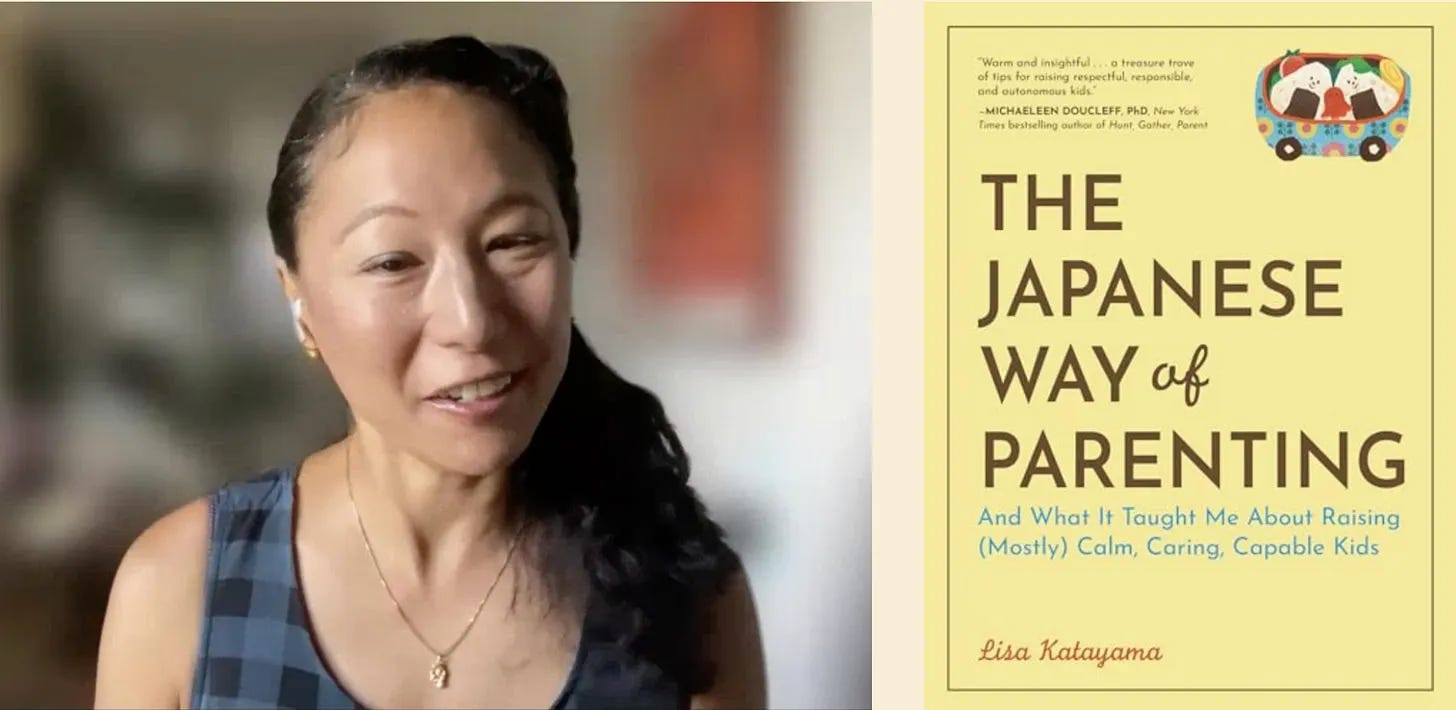
Lisa Katayama
Language offers a bridge between home and school. Common expressions that children become familiar with early on in both places include kashite (please let me borrow it), followed - in the ideal scenario, at least - by dōzo (here you go).
There’s a ritual quality to this. Children at my son’s daycare centre in Japan would say, slowly and deliberately, ka-shi-te while holding out their hands, treating it as an incantation that would pretty much compel the handing over of a toy car or a stuffed animal. If it didn’t work, the fall-back was usually to repeat the magic words, louder and ever more distinctly, until the other child gave in or a sympathetic adult intervened.
A testament to the power of language is that even once her first child had finished at the Japanese daycare centre in California, Lisa found that by switching from English into Japanese when asking her daughter to do something she was more likely to get agreement.
The art of parenting this way outside of Japan seems to be to combine the best of how it’s done there with the best of what you find where you live.
For Lisa, this is about nurturing in her daughters the strong sense of self that’s natural to American culture. She tells me she’s not against the posters that American children make in their schools, focused on ‘Who am I?’ and ‘What do I like?’ They just need tempering with attention to others:
I want my daughters to be opinionated and resilient, but I also want them to understand when it might be appropriate to concede to someone else's (or society's) will.
I'm not always successful at this. I think they are first and foremost turning into free-form, ambitious West Coast kids. But underneath there is a layer of Japaneseness... a sense of what's right, what's fair, what's respectful of those around them. And my hope is that as they grow, this base layer will continue to guide them in making decisions that are both their own and considerate of everyone else.
I love this idea, and it points to another reason why ‘conformism’ was never a very useful way of understanding Japan. The parenting and education that Lisa talks about in her book aren’t primarily about control; what matters is shaping children into moral and social agents - providing the structure, but giving them dignity, respect and power within it.
You clean your classroom not because you’ve been ordered to but because it’s your classroom. Everyone gets their own job. There are class meetings.
It reminds me of the Michaela school here in the UK - regularly touted in our media as ‘Britain’s strictest school.’ Their ‘family lunches’ involve pupils serving and cleaning up after one another, everyone with their own role to play. ‘Strict’ doesn’t do it much justice - this is agency over enforcement. And that’s what, despite the undoubted pressures that its education system and wider society place on people, Japan has been pretty good at with its children.
If you have thoughts on education, trust and how I can get my teenagers to do my bidding, please feel free to leave a comment. Meanwhile, Lisa’s book is out now - and it’s well worth a read, whether you’re a parent or you’re looking for a new way of understanding Japanese values.
—
Images:
Japanese fans cleaning stands: BBC (fair use).
Lisa Katayama: still shot from interview with author.
Great piece! It's not about homogeneity, because you can see mixed race kids and foreign kids happily taking part in the sharing when they grow up in a Japanese community. I rebelled against my wife's Japanese parenting of our daughter until it dawned on me that I could relax and contribute other values, like independence, in a way that would fit comfortably within the larger "omotenashi" mentality that she was teaching. Our daughter is 21, working here in Japan, and still happily maintaining an awareness of those around her.
I've read an article by Ms Katayams wrote for The Economist a few years back about how children are raised in Japan. Wonderful piece. I can't wait to read the book. Thanks, Chris, for sharing these Lisa-thoughts with us.