


It’s that time again, when I find out where my children’s real loyalties lie. When push comes to shove, will they support Japan or England in the World Cup?
At the moment, all’s well: we’re cheering both teams on. But on my slightly amateurish projections - correct me in the comments if I’m wrong - Japan and England may meet in the quarter-finals. At that point, I will be sitting at the opposite end of the sofa from my Japanese wife, and we’ll just have to see which way the children break…
As usual, the UK media is awestruck that Japanese football fans clean up after themselves when the game’s over - in contrast not only to England fans joyfully spraying the stands with beer but also, according to Japanese women taking to social media in recent days, to those same Japanese fans leaving the cleaning of their own homes to their wives.
Cliché though it may be, the ‘tidy fans’ image is part of a powerful and under-appreciated aspect of Japanese soft power. Anime, manga, food and computer games get a lot of press. Sport deserves more.
Baseball has become the Japanese national game, arriving there in 1872 when an American professor introduced it to his students. But football reached Japan the very next year, courtesy of a British Royal Navy officer who decided to get Japanese cadets playing it.
It was from Britain, too, that the men’s football team gained their kit colours. The two big universities in Japan in the early twentieth century were Tokyo Imperial University and Kyoto Imperial University. In order to differentiate themselves in rowing competitions, they emulated the famous rivalry between Cambridge (light blue) and Oxford (dark blue).
After drawing lots, Tokyo got light blue and Kyoto took the dark. When Tokyo Imperial University’s football team represented their country in 1930, they wore the university’s light blue, won, and the colour stuck.
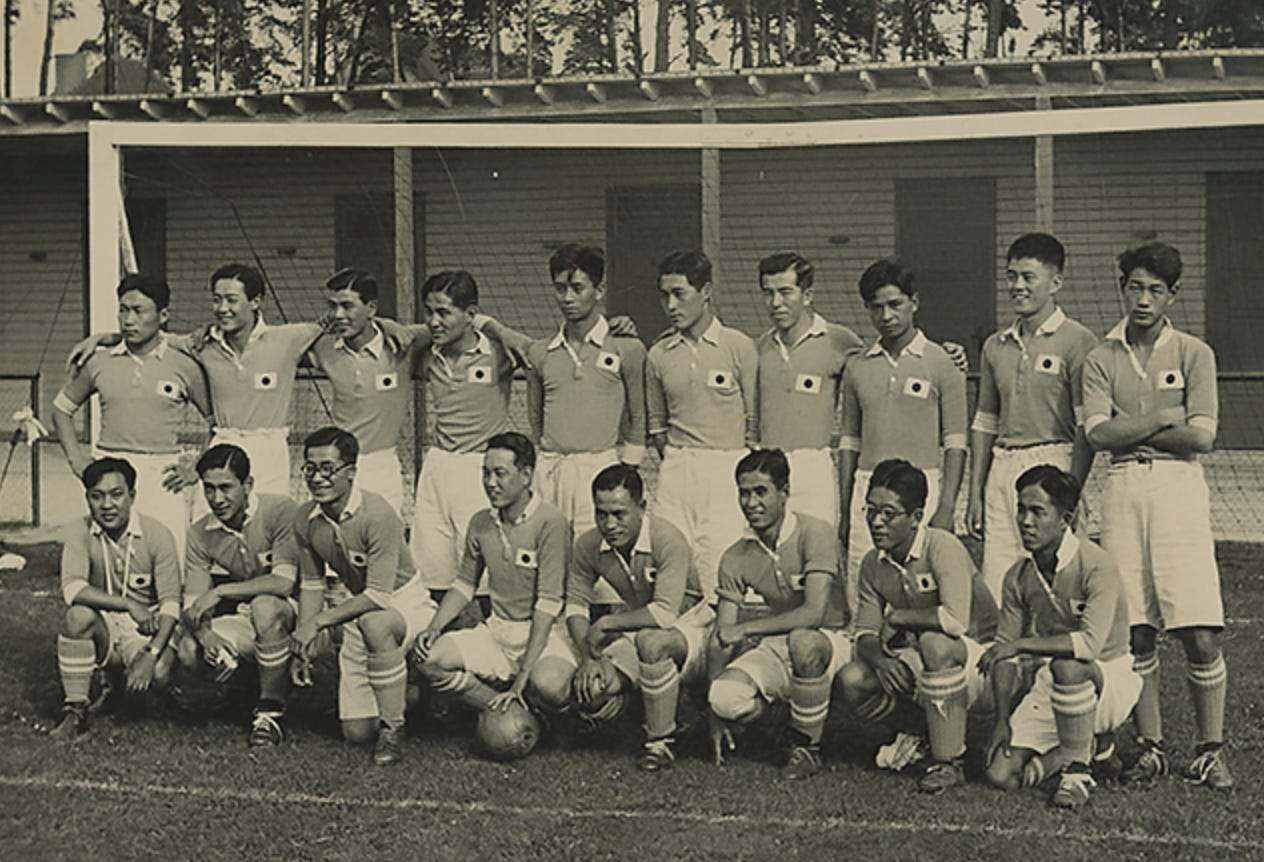
Six years later, the Japanese men’s team faced Sweden at the Berlin Olympics - duly kitted out in blue, though the shade became steadily darker. In a sign of viciously racist times, ahead of their encounter a Stockholm newspaper reportedly declared: Slår vi inte dessa snedögda halvapor med åtminstone 10-0 är vi inte längre ett kulturfolk - ‘If we don't beat these slant-eyed half-apes by at least 10–0, we are no longer a civilised people.’
Assuming this story is true - and some doubt it - then maybe this ugly pre-match boast was leaked to the Japanese team at half-time. Having gone two-nil down, they roared back in the second half to take the game 3-2. For the Swedish newspapers, it was nothing short of a national humiliation. In Japan, it came to be known as the ‘Miracle of Berlin.’ Here’s the squad:
Tragedy intervened, in Europe and the Asia-Pacific, but sport became a huge part of Japan’s postwar image around the world - litter-pickers included. The 1964 Tokyo Olympics was a major come-back moment, showcasing a peaceful, high-tech country and featuring the vaguely raunchy-sounding ‘Blue Impulse’: the aerobatics team of the new Japanese Air Self-Defence Force.
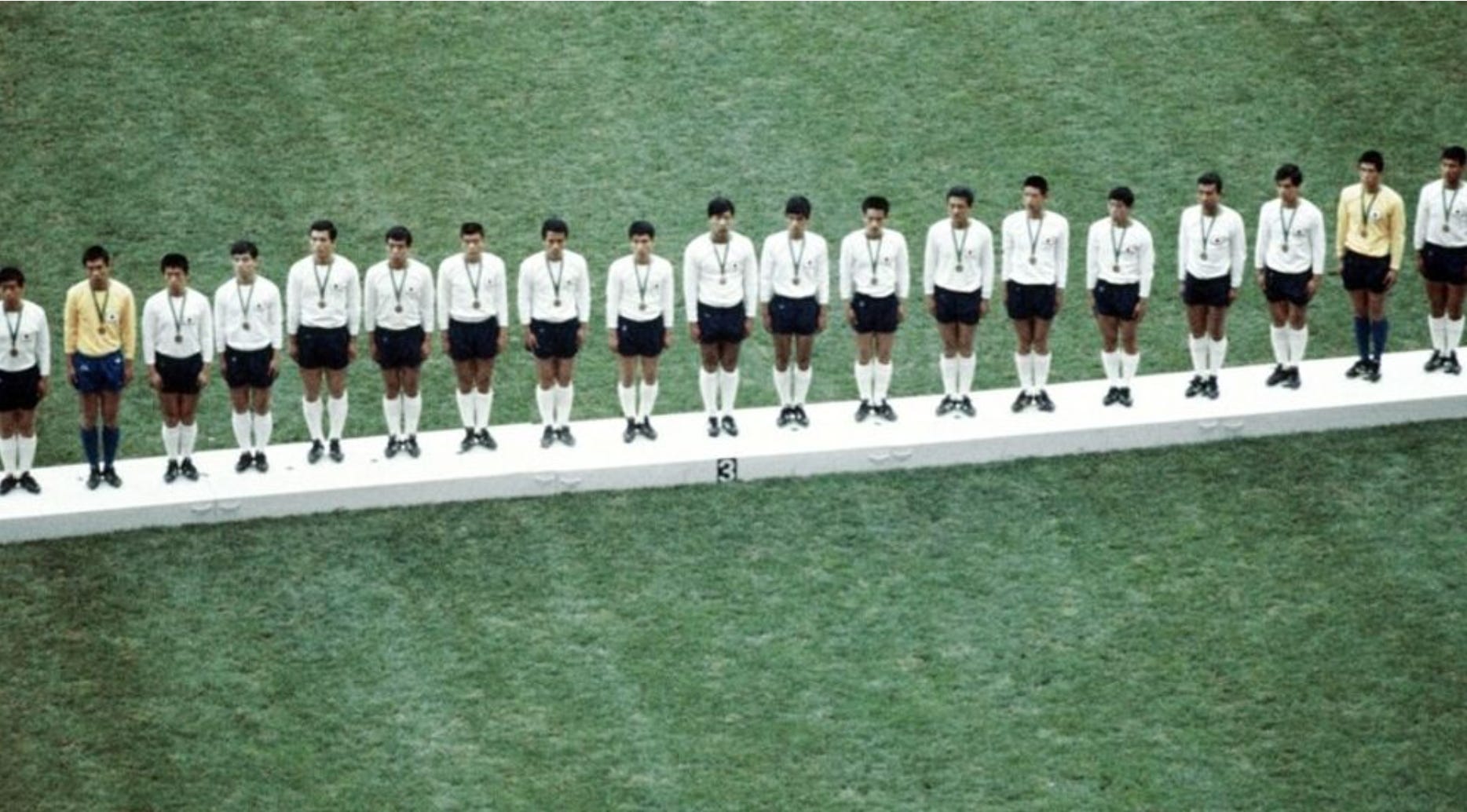
The men’s football team - under the branding of ‘Samurai Blue’ since the 2000s - went on to embrace the role of plucky outsiders at international tournaments. Their finest hour so far came at the 1968 Olympics in Mexico, when they beat the host nation to take third place. Not bad for a team made up of ordinary salarymen, who went from training together after a day at the office to having bronze medals hung around their necks in front of a vast crowd at the Azteca Stadium:
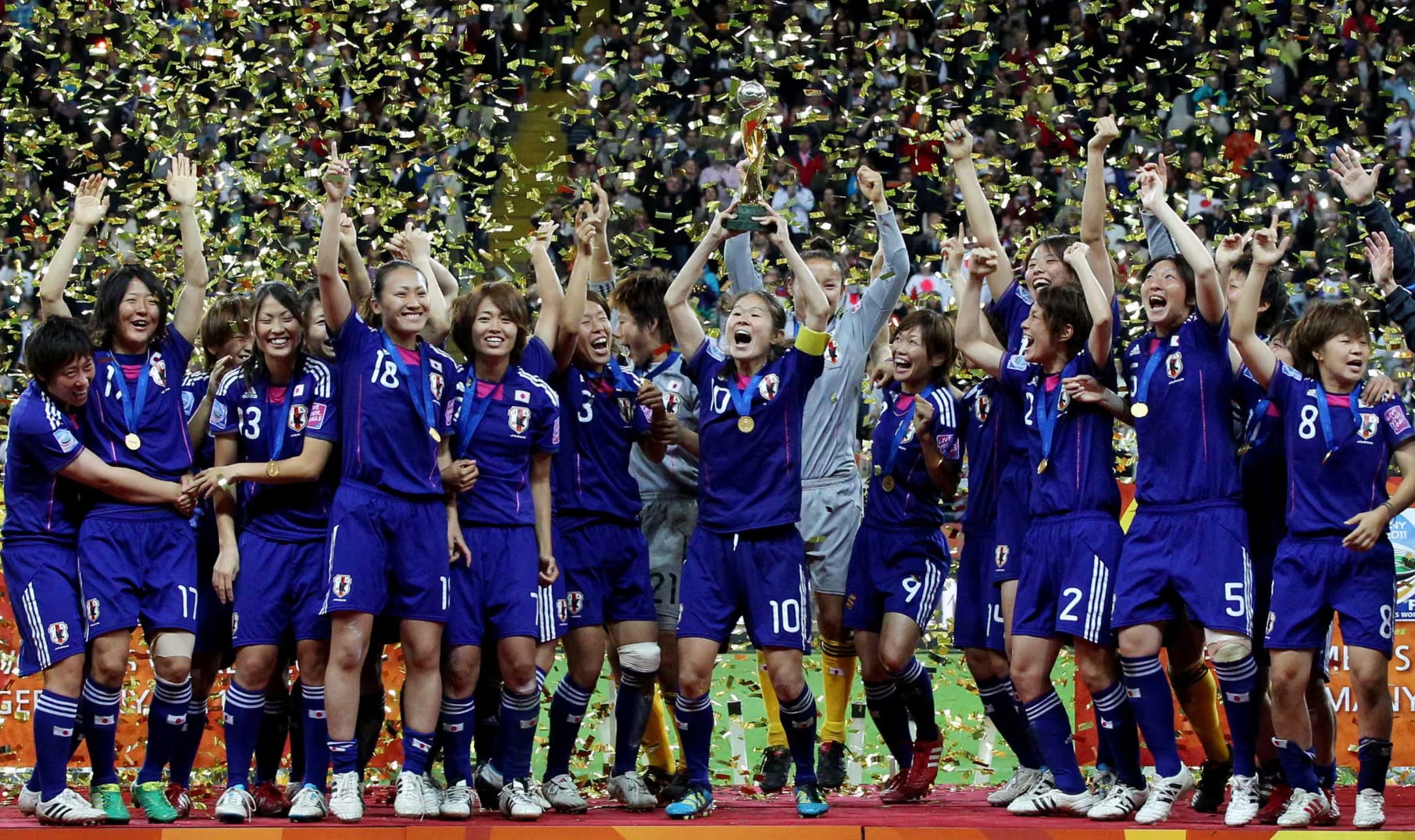
The men’s team went fully professional in the 1990s, but they have yet to equal the achievements of the women’s team, which was formed in 1981 and managed just thirty years later to win the FIFA Women’s World Cup, in Germany in July 2011.
It was a beautiful moment, coming just months after the triple disasters of March 2011: earthquake, tsunami and nuclear meltdown. One of the squad members actually had a day job at the nuclear plant where the meltdown occurred. Still grieving for what had befallen their country, the people of Japan very much needed a moment like this:
So we’ll let Japan have 2011.
But 2026 as well? We shall see...
—
Image credits:
Japan’s 1936 squad: The JFA (fair use).
Japan’s 1968 squad: The AFC (fair use).
Japan’s victorious women’s team: Guardian (fair use).
Great article as usual Chris, had no idea the colours came from Oxbridge rivalry, although it makes total sense.
I had feint memories of them playing in red and it turns out they did during the “Yokoyama Era” (1988–1992) to better reflect the colors of the Japanese national flag. But they ditched it after failing to qualify for the 1990 World Cup and the 1992 Olympics.
Apparently the 2026 away shirt - designed on the theme of “colors beyond the horizon”- white with multicolored stripes is in massive demand due to its fashion appeal.
I seriously hope it doesn’t come to England vs Samurai Blue - one, England could lose as they did at Wembley recently, and two, I will have to tread that fine line of consoling my wife and brother-in-law whilst inside giving it a resounding ‘get in my son’!
I haven't watched a single match for years; I don't like football at all. But I happened to see the 2011 tournament! Coincidentally.
Anyway, I don't follow any similar events, but if I were to bet, I'd put my money on Korea or Japan reaching the quarter-finals or something like that. For a reason that might sound completely odd to seasoned fans: those teams had limited exposure to COVID compared to others, which might give them an edge when playing against teams that would have been considered slightly better on paper in the pre-pandemic era. Idk, it's just a guess from a total layman.