


No road trip in Ireland, it turns out, is complete without several packs of these:
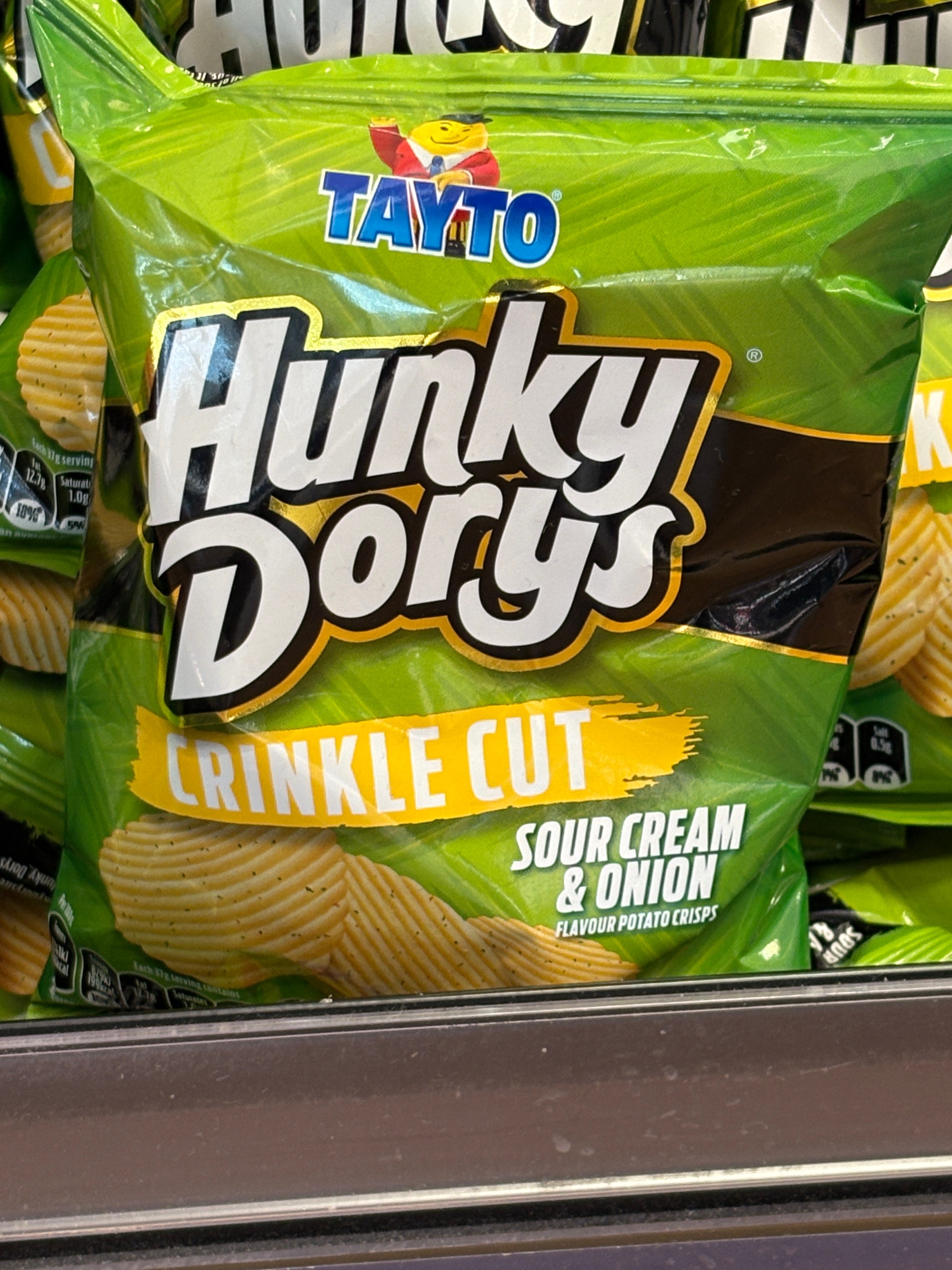
The name ‘Tayto’ apparently comes from the way the young daughter of the company’s founder, back in the 1950s, pronounced the main ingredient of crisps.
The brand has since become synonymous with its product, in the way that Hoover and Google managed with vacuums and web searching. You hoover the carpet. You google something. And if you’re in Ireland, and healthy eating doesn’t interest you, you rustle up a tayto sandwich.
But what about ‘hunky dory’?
The first recorded uses of the phrase come from the United States in the 1860s. They include a song sung by what appears to have been an Irish-American minstrel group, to the tune of Limerick Races:
One of the boys am I,
That always am in clover;
With spirits light and high,
‘Tis well I’m known all over.
I am always to be found,
A singing in my glory;
With your smiling faces round,
‘Tis then I’m hunkey dorey.
In the same decade, you find people in the US beginning to complain about the expression, as part of a roster of new and unwelcome slang words:
I cannot conceive on any theory of etymology that I ever studied why anything that is ‘hunkee doree’, or ‘hefty’ or ‘kindy dusty’ should be so admirable.
By far the most entertaining speculation - and this comes with a health warning, because etymologists will point out that no real evidence exists - is that ‘dory’ originates with the Japanese word dōri, for ‘street.’
Even more of a stretch - but let’s enjoy ourselves here - is the claim that the full expression ‘hunky dory’ might come from honchō dōri: ‘Main Street,’ in the port town of Yokohama - which Americans and other westerners began to frequent in 1859.
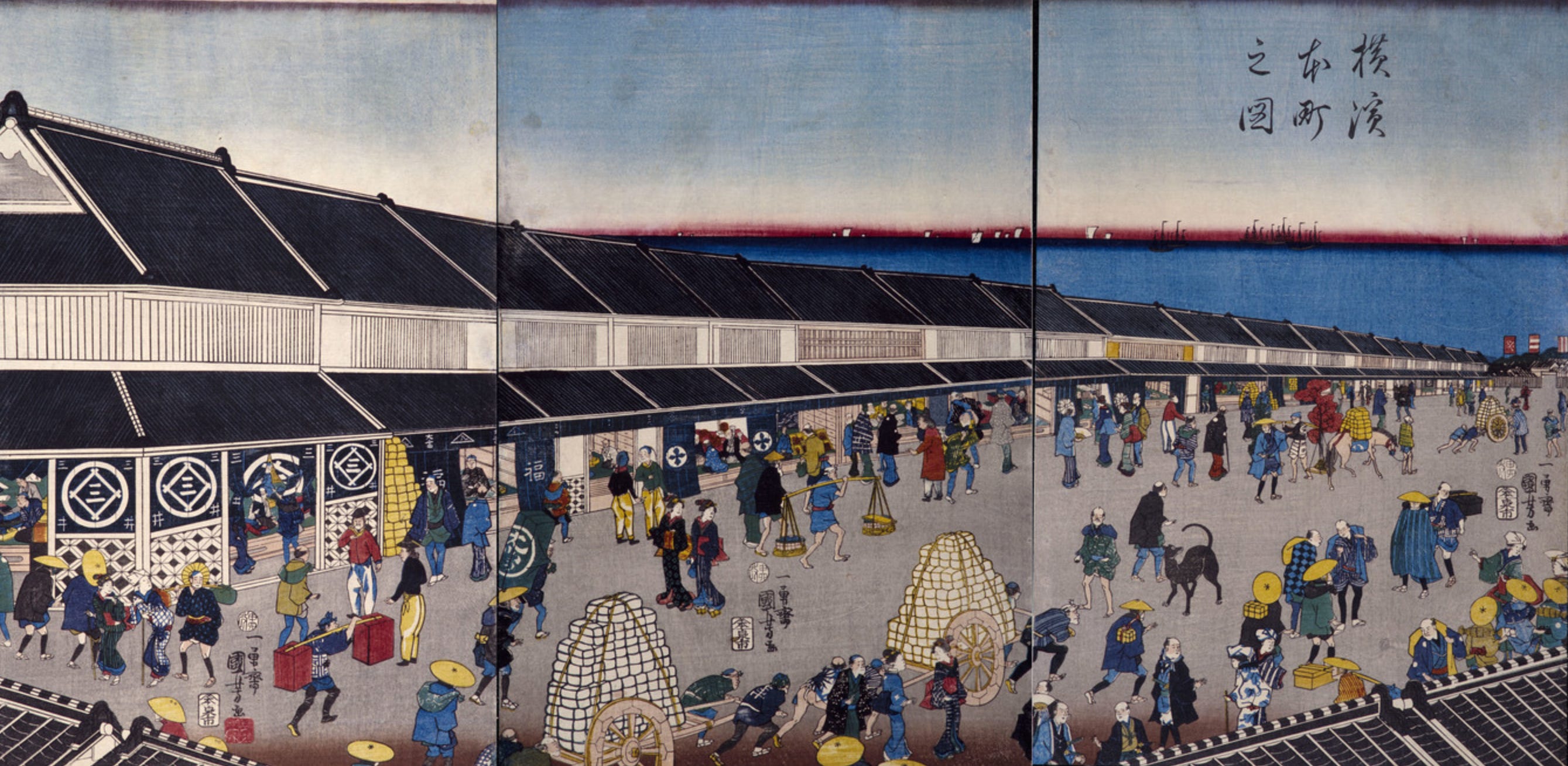
Honchō Dōri, Yokohama (1860): woodblock print by Utagawa Kuniyoshi
Yokohama was by all accounts a riotous place, in these early years. One English observer claimed that it attracted the ‘scum of Europe.’ Another told of fights breaking out in the middle of the night, and of guns being fired, seemingly for no reason.
Japanese curious about foreign people, fashions, food and music found themselves drawn to the port town and its bustling Main Street, as one might be to a circus or an open-air theatre production.
Much of the energy on Main Street seems to have come from the rather flawed early relationships that grew up between Japanese and Westerners.
Shopkeepers were keen to relieve foreign visitors of their cash in exchange for porcelain, lacquerware and bronzes of such dismal quality that no Japanese customer would have given them a second look. Japanese merchants were accused, meanwhile, of providing excellent tasting samples for tea - and then, having made the sale, handing over a far inferior product.
Westerners meanwhile appear to have struggled to suppress their sense of cultural superiority. As an Irish doctor working in Yokohama put it: ‘We may disguise it as we like, but we are a set of tyrants from the moment we set foot on Eastern soil.’
It’s tempting to imagine that, leaving aside moments of anger and frustration, there was also a sense of merry chaos about Main Street, which might just - just - have persuaded one of the first modern visitors to Japan to associate it with a warm sense of contentment. We certainly find this a few years later, with the Irishman Lafcadio Hearn referring admiringly to Japan as a ‘fairy-land.’
So it may have been that Honchō Dōri became ‘hunky dory.’
No doubt the real origins of the expression lie elsewhere. But this is where they should lie - in this great, colourful moment of East-West connection.
Lest the etymologists come for me in my sleep, let me finish with some English expressions that really do have reliable connections to Japan:
Head honcho (the main boss) → from the Japanese word hanchō, meaning ‘group leader.’
Rickshaw → from jinrikisha: ‘human-powered-vehicle.’
Tycoon → from taikun, ‘great lord,’ used for a while by westerners referring to the shogun.
Thank you for reading! If you’re enjoying the newsletter, please do spread the word:
Meanwhile, for more on early Yokohama I recommend Simon Partner’s book The Merchant’s Tale. Simon is also now on Substack, so do take a look.
—
Images
Woodblock print of Yokohama: Yokohama Museum of Art (fair use).
I enjoyed that you give the Honcho-dori theory a clear health warning and then ask what the story reveals even if the etymology is wrong. The portrait of early Yokohama, with curiosity, commerce, exploitation, and cultural arrogance all occupying the same street, is more interesting than a tidy origin story. Ending with the better-attested examples also gives the speculation a useful boundary.
I believe https://oldphotosjapan.substack.com will have photos of old Yokohama sometime soon, at least I hope he will