


In 1946, Japan’s national broadcaster NHK paid a visit to Yokohama. Keen to put the new spirit of democracy into the production of radio programmes, they had put together a competitive singing competition - the Pop Idol of its day, basically - called ‘Proud of my Voice’ (nodo jiman).
Lining up to take part was one Misora Hibari, not yet ten years of age.
During the war her father, a fishmonger, had taken her to listen to the latest records in their local music shop. Foreign musical influences were steadily being erased from Japanese record shops and radio at the time, but the Japanese ryūkōka - ‘popular songs’ - that remained were an international blend in their own right. American jazz, chansons, tango, rumba and Hawaiian music all entered Japan via ocean-liner bands performing in port cities and then leaving recorded and sheet music behind.
By around the age of five, Misora was staging mini song and dance performances at home. She would make family and friends sit down on one side of some fusama (sliding partition doors) and then open them with a dramatic swish, smiling around benignly at her audience before breaking into song.
When her father returned from the war, he formed the ‘Star Misora Band’ as a backing group for his talented little daughter. The name Misora, meaning ‘beautiful sky,’ was chosen for her as a stage name by her mother, Kimie.
NHK was Misora’s big break. Already an accomplished performer, there was no doubt that she would win the competition, thanks to a rendition of Ringo no Uta - ‘Apple Song’. The main tune from a recent hit film, it was a guaranteed tear-jerker. Radio gold.
And yet when Misora began to sing, something strange happened. Her first two verses were greeted with an ominous silence. Then all of a sudden the radio announcer broke in and asked her to stop.
What had gone wrong?
If you’re a paid subscriber to my newsletter, thank you very much for your support and your faith in this project. If you’ve yet to make the leap, you can do so for as little as £2.50 per month. You’ll be supporting my efforts here and elsewhere on YouTube and Instagram to bring Japanese history and culture to bigger audiences.
The problem with Misora’s performance was not the song itself. The Apple Song’s lyrics were famously banal: ‘the apple’s lovable, lovable’s the apple.’ But the judges found it unacceptable - even, it seems, a little creepy - that a child should be singing an adult song.
In other areas of Japanese culture, the child and adult worlds were brought together soon after the war. Manga artists like Tezuka Osamu wanted to make sure that children understood how corrupt the adult world could be, so that they didn’t allow themselves to be led again down the road to authoritarianism and war.
But in the case of songs like the one Misora was singing, there was something extra going on. And it would come out more clearly as her career progressed.
Despite the setback with NHK, within a couple of years Misora found herself performing to ever-larger crowds in Yokohama and Tokyo. For many of the people who came to see her, she was a bright light in an otherwise dark world.
People making their way to her concerts had to weave their way past rubble, bomb craters and homeless shelters. Almost all had lost loved ones and few knew where the future would take them. They brought all that sadness and trepidation into the auditorium and took their seats. Then the house lights dimmed and the stage lights came up. A little girl appeared on stage, breaking into a cheeky smile, a bashful jig and a song of luminescent joy or sorrow. Under cover of darkness and the sound of the band, people dissolved into tears.
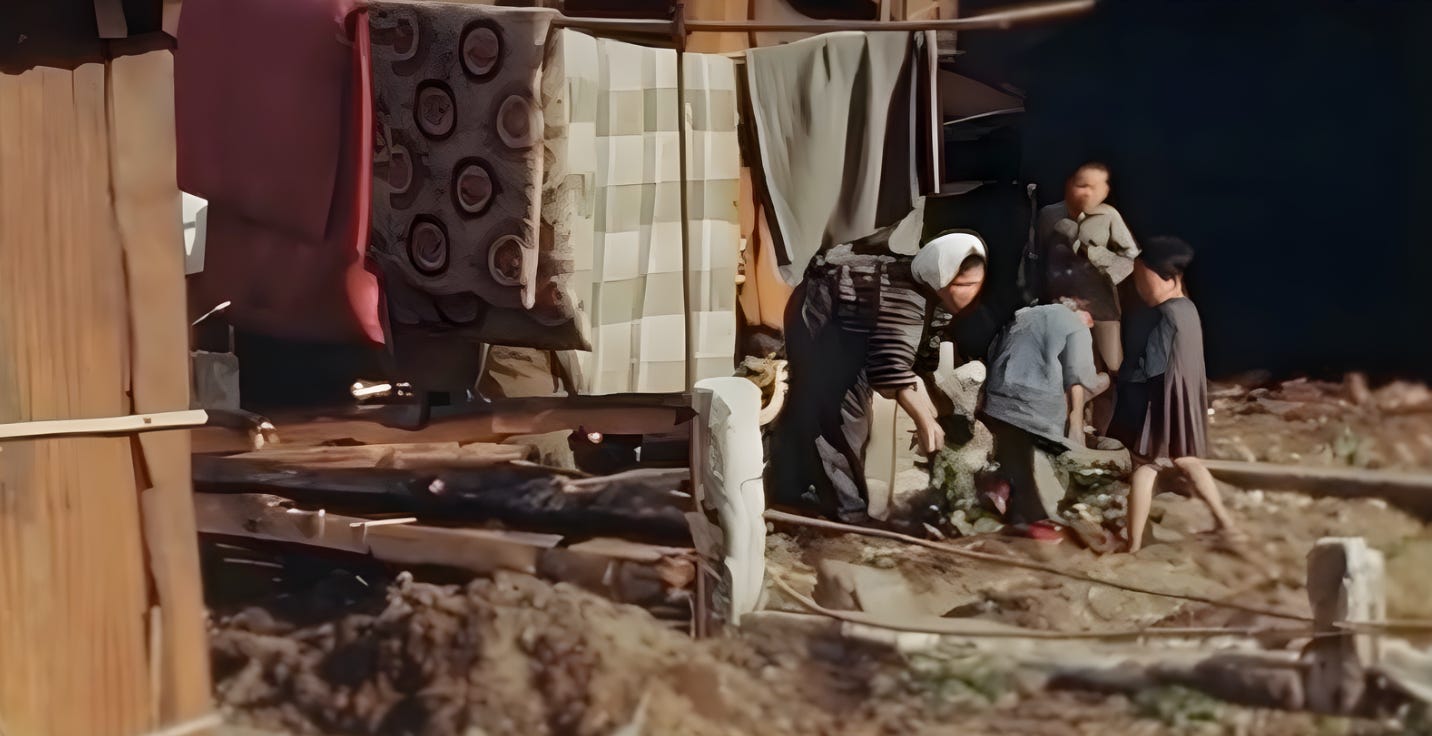
A bombed-out neighbourhood, possibly Tokyo, caught on film in either late 1945 or early 1946.
Much though her fans tell us about the Occupation as a turning point moment in Japanese history, Misora’s detractors are even more interesting.
The unease that those NHK judges had felt in 1946 was repeated two years later in 1948 when Misora walked out onto stage at around 11 years of age with a cigarette in her hand, a bag over her shoulder and tears in her eyes, singing a song – ‘In the Flow of the Stars’ (‘Hoshi no nagare ni’) – about a young woman turning to prostitution amidst the hardships of war:
In the flow of the stars, I go,
Where will I sleep tonight, where will I stay?
My heart is hard,
My tears have dried,
Who turned me into a woman like this?
Newspaper columnists and letter-writers didn’t hold back. ‘Monster.’ ‘Beast.’ ‘A deformed adult.’ ‘Drenched in evil.’ ‘A sin.’ ‘It chills my blood.’ ‘I wanted to throw up…’
What was going on?
Misora, it seems, was offering ugly proof of a stark claim made by some Japanese both around this time and since: that having defeated their enemy in a conventional war, the Americans promptly launched a culture war.
There was truth in this. American analysts believed that Japan had modernized, over the past half-century or so, only in a superficial way. They’d acquired suits and ties, trains and trams, parliament buildings and post offices. They were pretty good at industry and science, too, though in the latter sphere sniffy western counterparts regarded the Japanese as being imitators rather than innovators.
But a feudal mindset had endured, claimed the US, rotting Japan from within. American-style democracy was the answer.
The result was images like these, from a publication called New Constitution Bright Life. It was a guidebook to Japan’s American-authored post-war constitution:
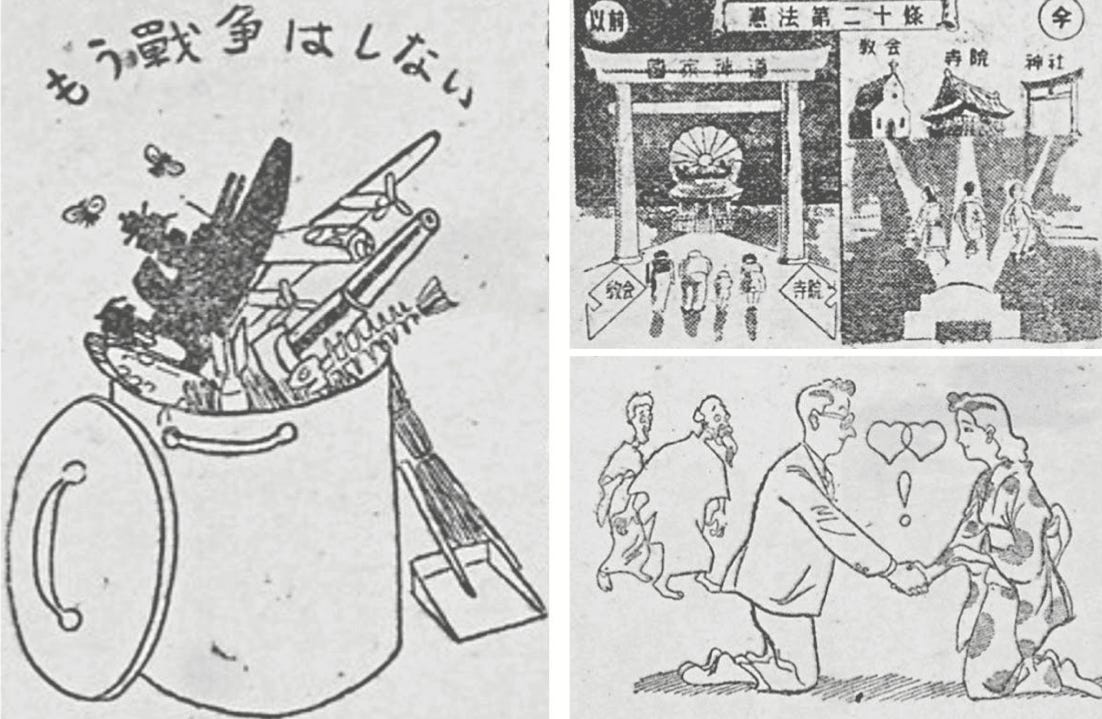
On the left, the caption reads ‘no more war.’ Top-right is a before-and-after image of Japanese attitudes towards religion. The dark ‘before’ image shows the torii gate of a Shintō shrine with an imperial chrysanthemum beyond it, implying the bad old days when religion and state were one. In the bright ‘after’, people have a choice of religious paths - including one that leads towards a torii gate stripped of its imperial chrysanthemum.
Finally, bottom-right, you have a new ideal for how friends and perhaps lovers should communicate: equality between men and women, shaking hands rather than bowing, and a mutual respect filling the air between them.
The Americans never seriously tried to ban bowing. But conservatives in Japan were nevertheless sure that Japanese society, culture and values were under attack. It was happening, they thought, not just through censorship and the passing of radical new laws but through an influx of American pop music, promoting the sexualization of women and even young girls. Alongside this music culture ran a notable rise in prostitution and crime around American military bases across Japan.
Some of Misora’s critics appear to have been motivated by a sense of the vulgarity of a fishmonger’s family getting rich. One noted that her mother, Kimie, enjoyed ‘putting a ring on every finger.’ But there was no doubt that seeing an 11-year old girl dressing like an adult woman and performing sexually-suggestive boogie-woogies caused serious consternation. One critic described her as performing the ‘music of a ruined nation.’
Misora’s minders went into crisis mode. The result was a film called Mournful Whistle (Kanashiki Kuchibue, 1949), which managed to reinvent Misora as a symbol not of exploitation or premature sexualization but of a wisdom and maturity hard-won during a time of war. Misora played a talented war orphan who overcomes tragedy and shares her good cheer and resourcefulness with all around her.
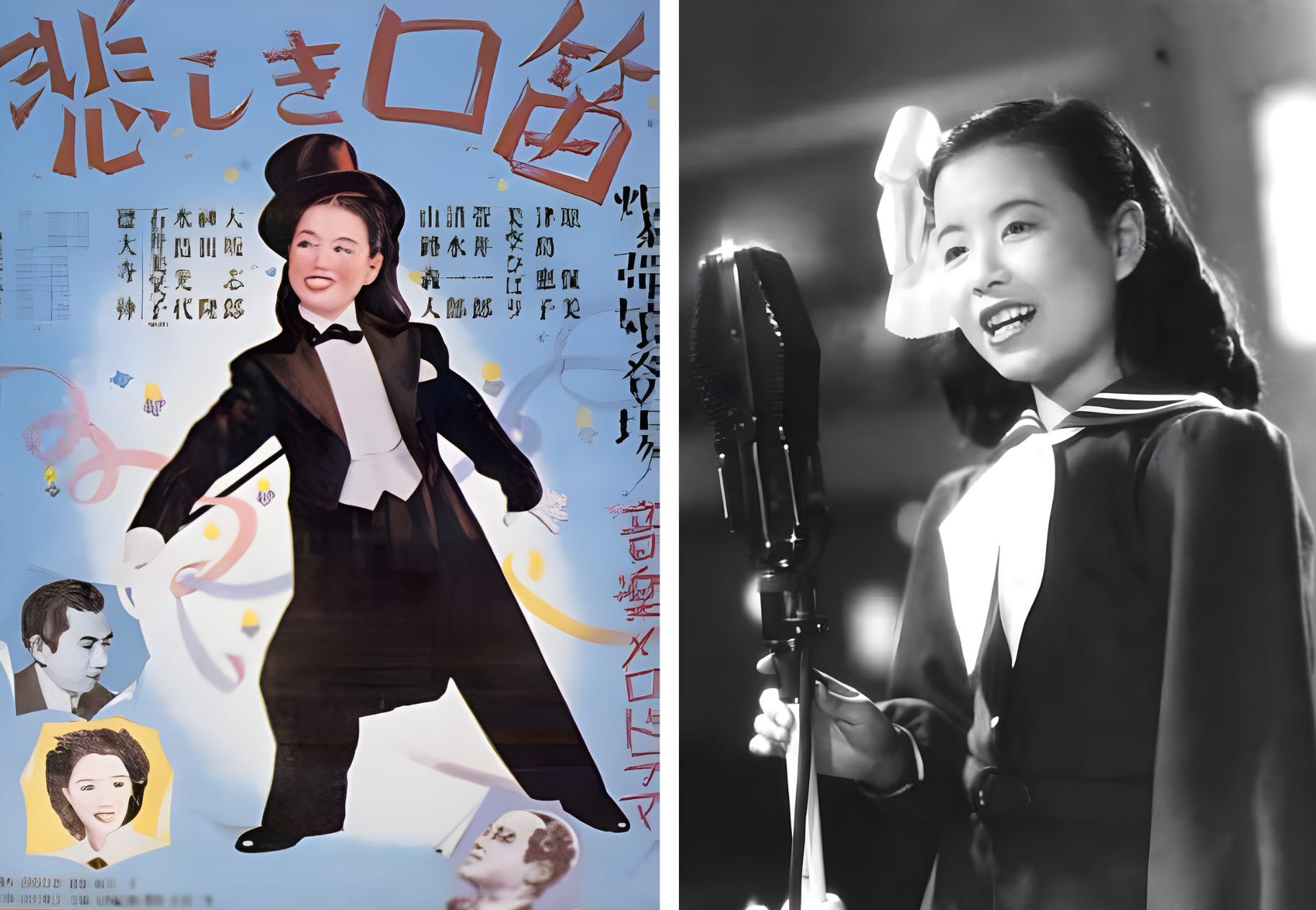
Above and below: Misora Hibari in her first major film role, Kanashiki Kuchibue.
More films followed, alongside a US tour. And by the time the Occupation came to an end in April 1952, Misora had entered the stratosphere. The starting salary that year for a bank clerk was around 72,000 yen. Hibari’s earnings for the year were in the region of 12 million yen. She later built herself a mansion, the ‘Hibari Palace’, sprawling across 3,000 square metres of prime Yokohama real estate. Tour buses cruised past, packed with people hoping to catch a glimpse of her.
Men and women who fell in love with Misora as a child star followed her through into her adult career. Those who lived long enough regarded 1989 as the end of an era: the death of Emperor Hirohito, but more importantly for some the passing of Misora Hibari. For others, she remained a symbol of the unstoppable tide of American culture, washing over Japan during and after the Occupation.
Not everything coming in from America was unwelcome. In the fourth part of this five-part series on the Occupation I’ll be looking at the journey to Japan of the tiny yet transformative transistor. This seed of Japan’s domination of late twentieth-century electronics was received and nurtured by one of the most famous companies of all time - Sony.
—
Images & Video
Bombed-out neighbourhood: Periscope Films (fair use).
New Constitution, Bright Life: Japan Story (fair use).
Hibari Misora (left): Wikipedia (public domain).

Hibari Misora (right): Showa-g.org (fair use).