


This week came the news that after testing around the streets of Tokyo, driverless taxis will start operating in Japan’s capital from next year.
It seems odd that the country that gave us driver-controlled automatic taxi doors back in the 1960s should be getting around to this only now. Trials have been going on since 2018, when Japan’s prime minister Shinzō Abe promised driverless mobility services by the time of the 2020 Tokyo Olympics.
But Japan’s tech lead has been slipping away since the 1990s, amidst a global shift from hardware to software, and from large corporations doing long-range research to start-ups funded by venture capital. That ended up favouring America’s West Coast, and it’s striking that in the Tokyo taxis deal just announced one of Japan’s largest taxi companies - Nihon Kotsu - will run operations while the truly cutting-edge tech and intelligence will come courtesy of the Californian company Waymo.
It’s a sign of one possible future for Japan: its industrial excellence continuing to matter, while American AI and Chinese-produced raw materials remain indispensable. It’s not an enviable position to be in, when the US alliance remains uncertain and relations with China are in deep-freeze over the Japanese prime minister’s remarks last year about Taiwan.
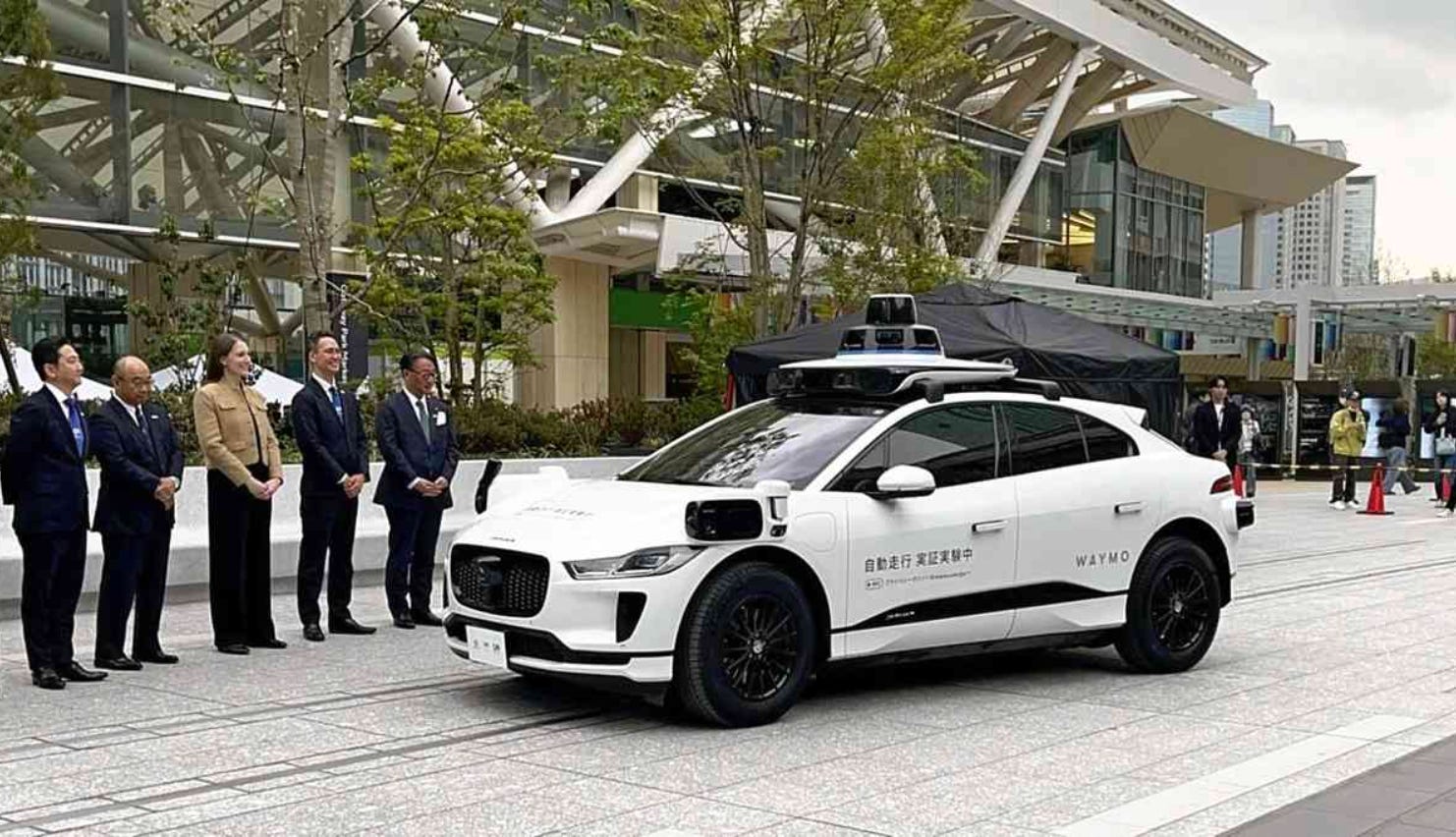
A Waymo car in Minato Ward, Tokyo
And yet signs are starting to emerge of another possible future.
The Real Gaijin substack reports that Toyota and Nissan are working hard on autonomous driving. And it was announced earlier this year that Japan will devote $6 billion to achieving AI autonomy. It will seek to develop its own ‘sovereign AI’ model - reducing reliance on American companies (though Nvidia is a partner in the new venture) - and will use it to power some 10 million robots by 2040. These will work in sectors like industry, infrastructure, health and defence, putting Japan at the forefront of what’s called ‘physical AI’ - in other words, AI-powered machines.
Japan has a lot of work to do here, in order to catch up and eventually get ahead.
Earlier this year, it was announced that Chinese humanoid robots are to be trialled at Tokyo’s Haneda Airport, heaving luggage and cargo around. Then came the World Humanoid Robot Games a few weeks ago, at which a robot beat Usain Bolt’s 100-metre sprint record:
But demographic pressures are helping to push the pace. New figures released in Japan a couple of weeks ago suggest that the potential taxi drivers of tomorrow are emerging at a very slightly increased rate. Births rose a little in the first half of 2026, compared to the same period in 2025. Still, Japan’s overall trend towards a smaller, older population will continue, making it urgent that the likes of ‘care-bot’ technology at last be mastered.
Part of the problem in the past was that early care-bots themselves needed looking-after: wheeling from room to room; having their batteries charged. They also couldn’t be trusted with handling frail human beings, since the engineering and intelligence required to make them gentle, responsive and dexterous remained out of reach. For anyone interested in why the much-hyped care-bot revolution of the 2010s didn’t happen, I recommend James Wright’s excellent Robots Won’t Save Japan (2023).
Even China hasn’t yet solved the dexterity problem. For all the impressive feats achieved by runners and kickboxers at the recent games, another robot failed to fold laundry. These are the sorts of problems that will have to be ironed out 😊 using the prodigious sums of money earmarked for AI and associated engineering in Japan.
Beyond the technical challenges lie human questions. Some are relatively modest. It wasn’t that long ago that people like me, who work mainly with academics and journalists, would only ever encounter something other than a liberal opinion in the back of a cab. This is easily solved: allow robotaxi users to set the personalities of their unseen drivers, along with their positions on the political spectrum. Maybe have a ‘shuffle’ setting, so you never know what you’re going to get.
More importantly, what about Japan’s fabled culture of omotenashi - its nothing-is-too-much hospitality? What about the steady shrinking of the time we spend around other people?
Old concerns about robots being unable to provide a sense of human connection appear to be morphing, now, into something else, as we re-think what connection means. AI agents and companions are becoming ever more normal, and countries like Japan are pioneering robot avatars for people - including those suffering with social withdrawal - who want to be ‘present’ somewhere, even while their bodies are at home.
Quite where ‘morphing’ will go is impossible to say, but it’s happening quickly. And it needn’t be all bad.
The promise of AI is supposed to be that we automate the routine in order to make space for the valuable: thinking, creativity, fun - time with loved ones. Perhaps the belated arrival of robotaxis in Japan marks the start of a similar principle operating in the world of physical AI, especially for the elderly and those living without easy access to transport.
You might feel a little uncomfortable embarking on your first robotaxi ride. But if it gets you out to dinner with your friend, when you might otherwise have been alone at home for the evening, then three cheers for that.
—
Images:
Waymo car in Minato Ward, Tokyo: Yomiuri (fair use).
I get the reasons why, but I'll be sad to see the classic taxis disappear. I just love the aesthetic of them