


On Saturday 5th May 1945, the Reverend Archie Mitchell and his pregnant wife Elsie were on an outing near Bly, Oregon, with five children from their church. Archie was standing by his car when he noticed that Elsie and the children had stopped to inspect what looked like the remains of a large balloon. Recalling recent rumours about strange objects appearing in the sky, Archie ran over, shouting at them not to touch it. He was too late.
When we think about the closing months of World War II in Asia, one of the big themes is the obliteration of much of Japan’s urban architecture by American firebombing. As the US General Henry ‘Hap’ Arnold put it, the intention was for Japan to surrender as a nation ‘without cities.’ We hear a lot less about Japan attempting during those same months to attack the continental United States. And yet they did.
Those attacks were a far cry from the kind of tech about which Japan’s pre-war scientists and fiction writers had dreamed. Some envisaged a ‘death-ray’ being fired from a remote mountain cave, lancing through the atmosphere and around the globe, before arriving in Washington D.C. and blowing up the Capitol.
Japan never got close to such a weapon. But a unique wartime combination of desperation, ingenuity and scarce resources led to the creation of a rather more basic fantasy-weapon: a balloon-bomb, known as Fu-Go.
Each balloon was around 30 feet across and made from hundreds of pieces of laminated washi (Japanese paper), filled with hydrogen. These were put together by, amongst others, schoolgirls - hairpins and long fingernails were banned - in spaces large enough to accommodate the finished product, from gymnasiums to sumo halls.
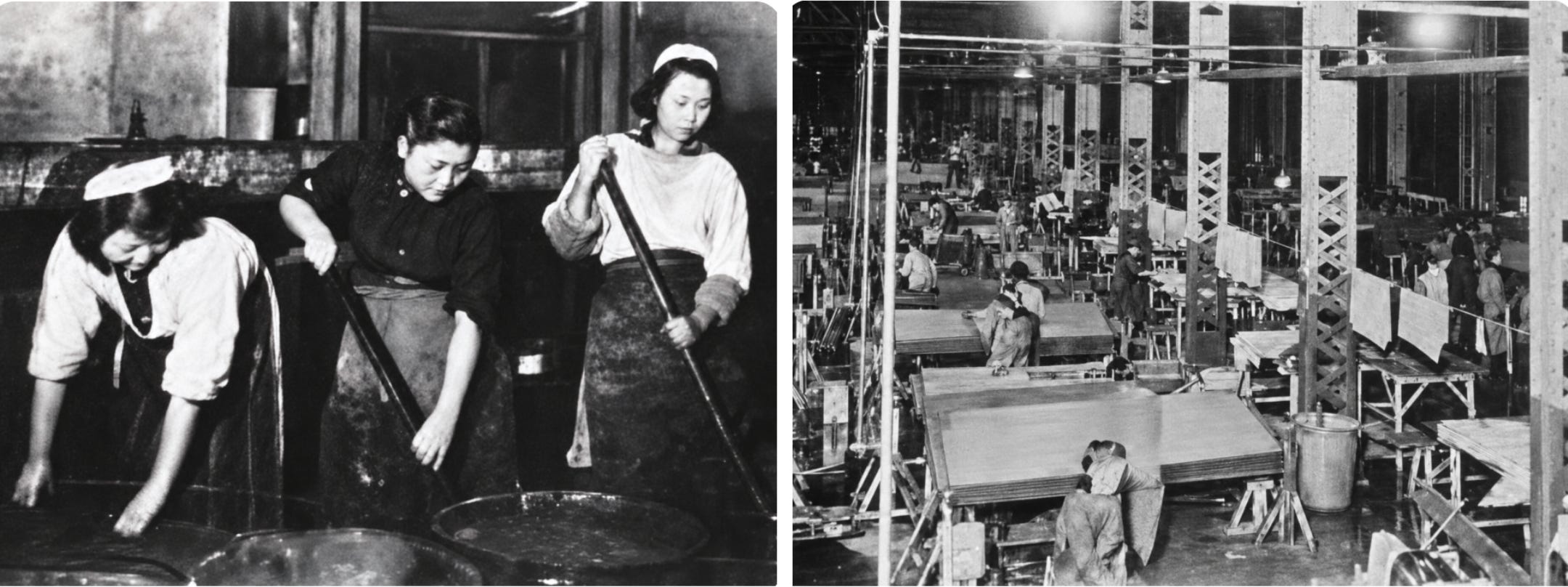
Above: preparing glue and drying paper
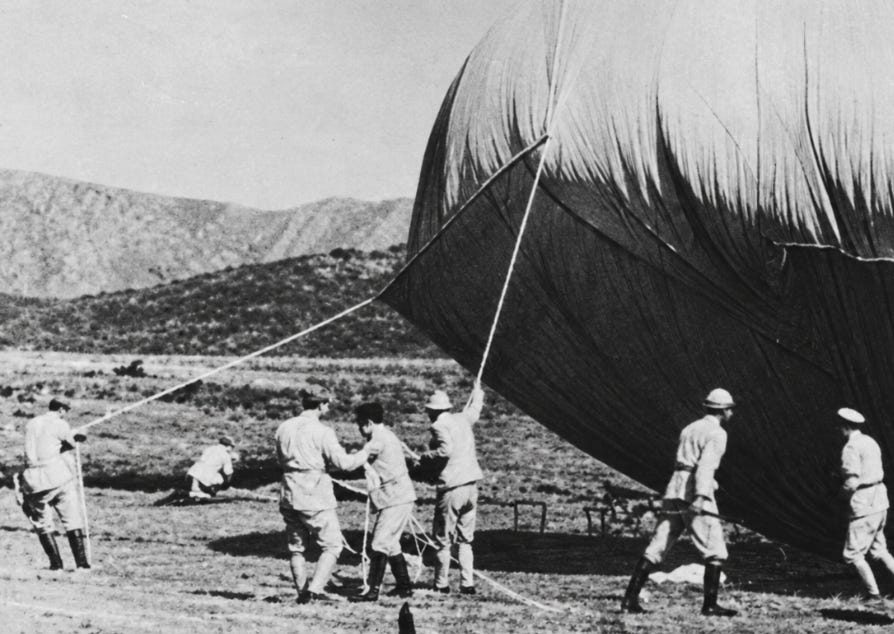
Below: prototype testing in spring 1944
Suspended beneath each balloon was an assembly of sandbags, batteries, incendiary devices, and sometimes an anti-personnel bomb.
More than 9,000 of these balloon-bombs were launched across the Pacific, equipped with cutting-edge instrumentation designed to hold them within the high-altitude winds of the jet stream. Almost a thousand are thought to have made landfall, from the Aleutians in the north down to Mexico in the south.
Early reporters of these eerie objects included a father and son out on an early morning fishing trip. They saw what looked like a parachute or a balloon-like object drift by overhead and then off behind a nearby hill. A few moments later, they heard an explosion and saw a puff of smoke.
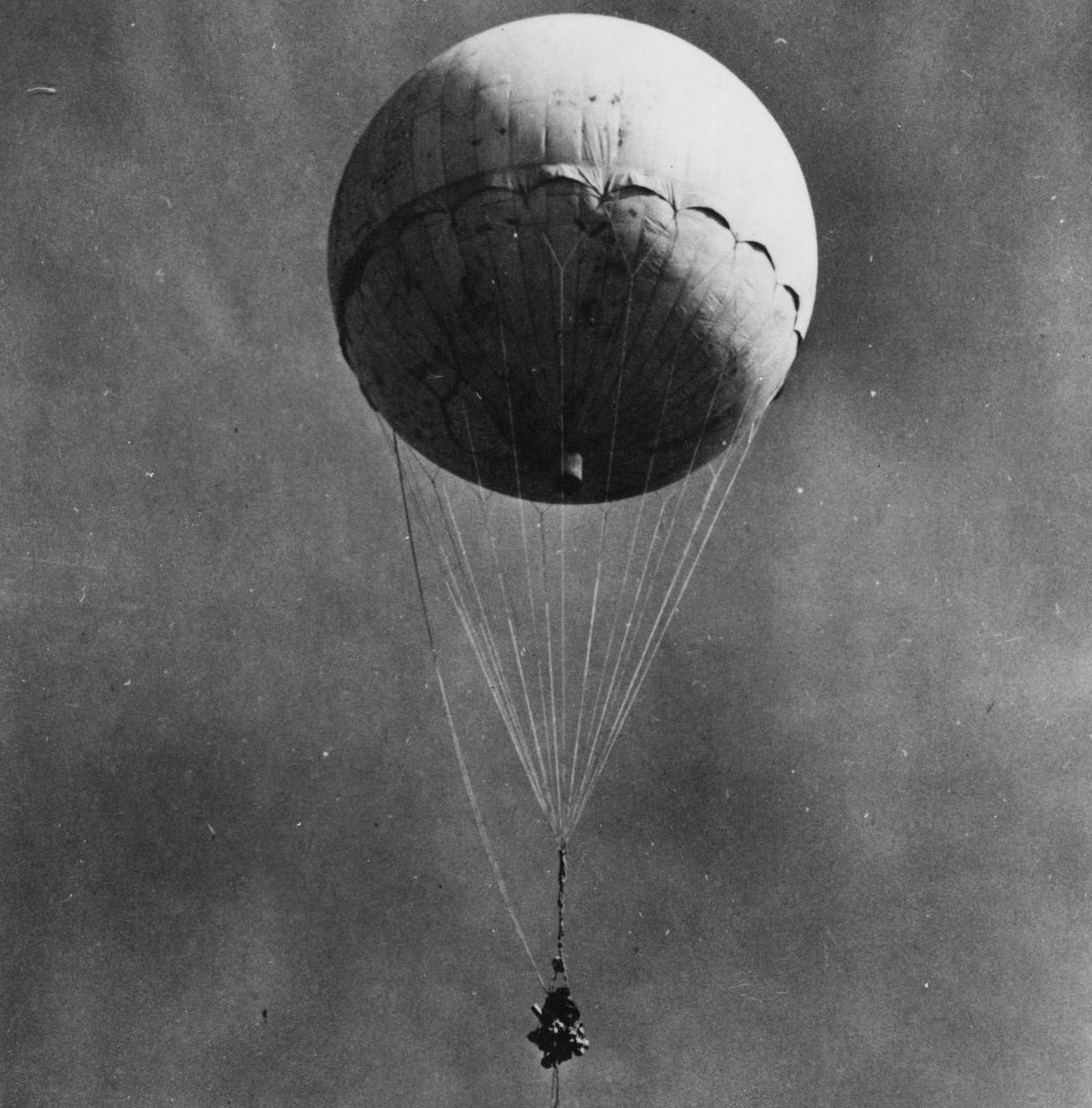
Type A balloon-bomb
The U.S. government decided to suppress news of these weapons, for two very good reasons. There was a risk of causing panic and damaging morale. And there was the danger that news about successful attacks would get back to Japan and help the enemy make their plans.
The downside was that the American public couldn’t be warned about these devices, and the danger of going near them. After press restrictions were lifted, Oregon’s Herald and News reported that when Archie Mitchell had been around 40 yards away from Elsie and the children, shouting at them not to touch what they had found, the device attached to the balloon exploded. Elsie and all five of the children died.
Back in Japan, government propaganda claimed that their new weapon had inflicted casualties on America ranging from 500 to 10,000 people. Claims were even made that a larger air campaign was just getting started. The next step, worried pessimistic American analysts, could be the placing of soldiers from the Imperial Japanese Army in pressurised cabins suspended from balloons - sending them off on the jet stream to cause havoc across the American homeland.
The Japanese hoped their balloon-bombs might persuade the United States to divert forces away from the Pacific theatre. This appears not to have happened to any great extent, but some US troops - including an African-American airborne unit - were positioned in western forest regions, ready to fight fires. Aircraft were launched in response to reported sightings of balloons, though only two were actually shot down.
In the end, the resources on which Japan’s balloon-bombs depended - hydrogen amongst them - were choked off by American B-29 bombers hitting Japanese cities with a far more effective new weapon: napalm. The press blackout in the US had meanwhile done its work. The Japanese authorities heard a lot less about the bombs than they had hoped, and concluded they were no longer worth valuable material and labour.
As for Archie Mitchell, witness to the only deaths in the continental United States caused by wartime enemy action, he later remarried and went to Vietnam as a missionary. Captured by the Viet Cong in 1962, he was never heard from again. Twenty-five years later, in 1987, a group of seven Japanese women who had once glued pieces of washi together to create balloon-bombs turned their hands instead to folding paper cranes. A thousand were carried across to Bly, where some of them remain to this day, in Archie Mitchell’s old church.
—
Thank you for reading! Please feel free to like, share, comment, and subscribe.
Images
Preparing glue and drying paper: exhibition entitled ‘The Balloon-Bomb Campaign and Preparations for the Decisive Battle on the Home Islands: The Girls’ War’ (fair use).
Prototype testing: Robert C. Mikesh, Japan’s World War II Balloon Bomb Attacks on North America (1973) (fair use).
Type A balloon bomb: Oregon Encyclopaedia (fair use).