


One of the things that first attracted me about Japan was the simplicity of Zen. I was a fan of philosophy at school but the people we studied always seemed better at taking down their opponents’ ideas than building up their own. On and on it went, from the ancient Greeks through to Bertrand Russell. Histories of philosophy started to read like murder mysteries where the story ends before anything has been discovered or resolved.
Imagine my excitement, then, at hearing about a way of looking at the world that began from the place where I had ended up: convinced that ideas and concepts are ultimately not enough in getting at life’s big questions.
Zen Buddhism didn’t just claim this. It could show it to be true, by introducing you to silence and the magic therein. As the title of one of my favourite books of the time put it: Sit Down and Shut Up.

Only later did I learn that this image of Zen is wrong - or, at least, it’s a modern twist on a very old tradition. For most of the past eight centuries, Zen Buddhists in Japan have, alongside their periods of meditation, spent plenty of time studying Buddhist scriptures and engaging in all kinds of rituals.
I was confused when I heard this. And things only got worse when I started visiting Japan. If Buddhism is basically atheistic, more a set of psychological insights than a religion - a popular view in the West, still now - then who were all these deities playing starring roles in Japanese temples and art? You might conceivably put a few images of your founder, the historical Buddha, in your place of worship. But this seemed to go far beyond that.
I found that the best way to clear away my misunderstandings and grasp what was actually going on was via a form of art known as a mandala. If you appreciate, even at an introductory level, what they’re about then you have a much better chance of understanding what’s going on in a Japanese temple - and in Buddhism more broadly.
If you go to a Buddhist temple in Japan, especially one associated with the Shingon sect, you’re likely to see something like this:
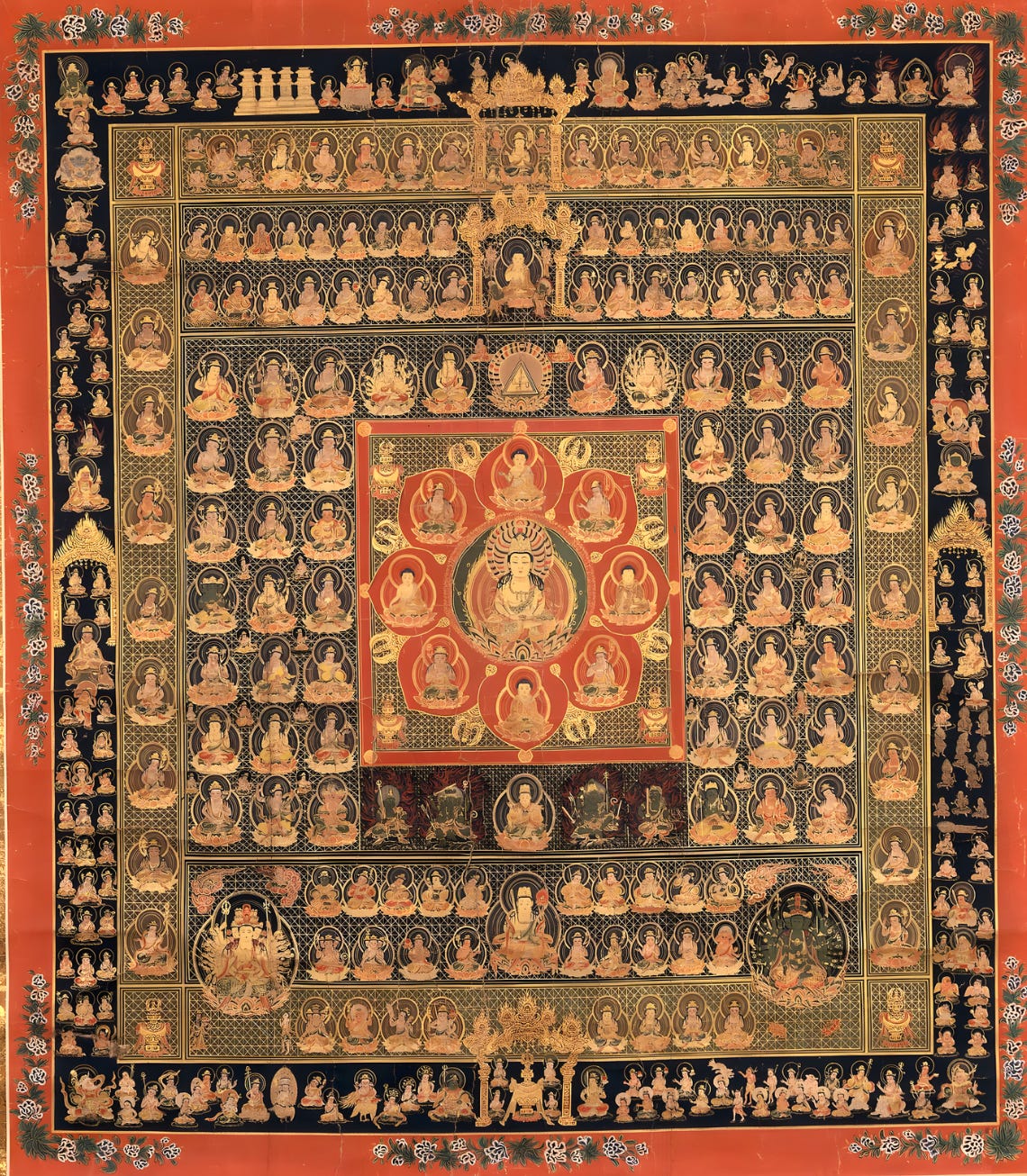
There are basically two ways that people have approached these images. The first, modern way is to appreciate them as pieces of art and perhaps - for those interested in Buddhism - to explore which deity symbolises which human virtue or emotion. Buddhism is, after all, famous for its profound exploration of what makes us tick.
This is fine, of course, and right down the centuries Buddhists across Asia have connected particular deities to things like compassion, wisdom, healing and mercy. But… they usually believed in the actual existence of these deities, too, and in their power to shape human affairs.
It was possible for both these things to be true at the same time - association with virtues or emotions and actual existence - because compassion, for example, was not understood as a merely human phenomenon. It was not a product of our (physical, brain-based) psychologies and societies. It was considered an independent force within the cosmos, which as humans we’re capable of receiving, cultivating and sharing.
The second way to look at a mandala is as a map of the cosmos. One which changes fundamentally depending on your angle of view.
We’re seeing it here face-on, but ideally you want to imagine two alternative perspectives.
The first is the view from the periphery. This is where, on some mandalas, you’ll find human beings alongside minor deities and demons. From this point of view, the cosmos appears crowded and chaotic.
The second perspective involves seeing the mandala from the central Buddha’s point of view. This, according to Buddhist tradition, is the truer point of view. Generally unavailable in its fullness to human beings, it makes clear that everything in the cosmos is an emanation from - and remains identical with - a single fundamental reality. That reality is represented here by the central Buddha, called ‘Dainichi’ in Japanese and ‘Vairocana’ in Sanskrit.
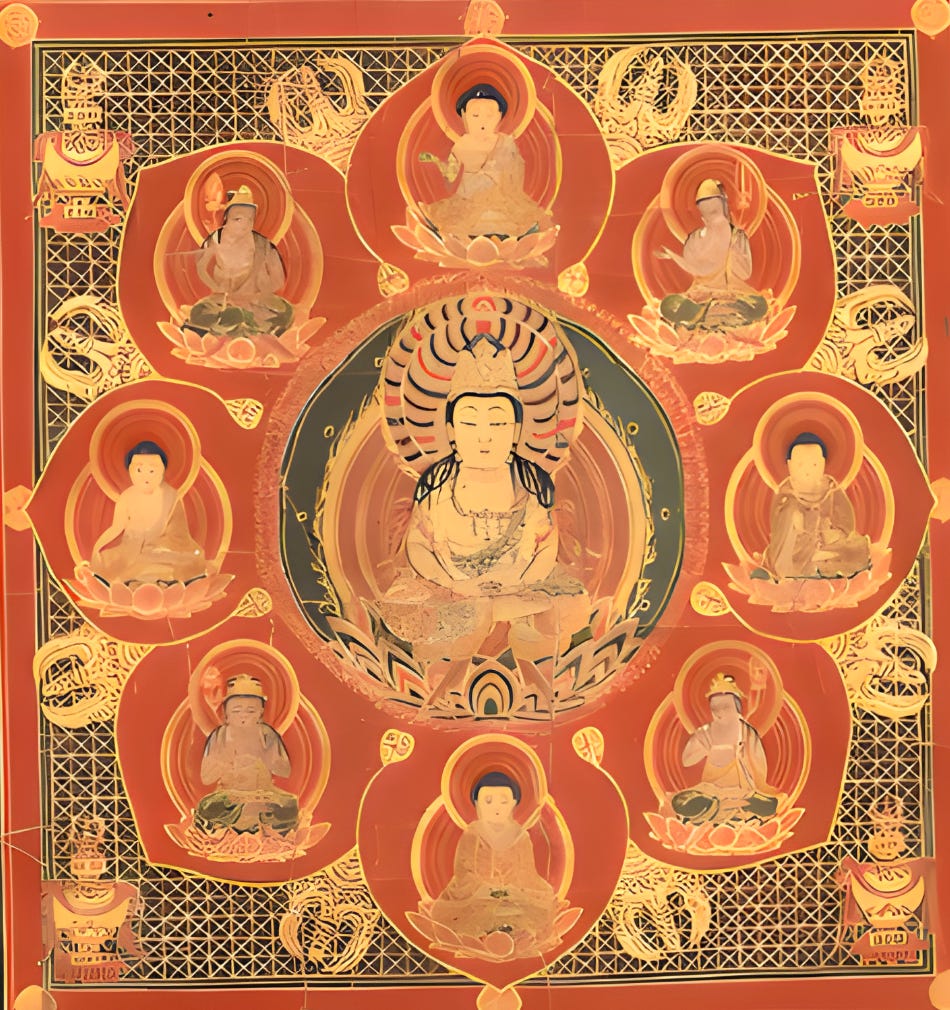
The spiritual journey, for those who undertake it, runs from periphery to centre: not towards the achievement of ‘enlightenment’ but rather the vivid realisation that you were enlightened all along. That journey is helped by the all-pervading compassion of the central Buddha. You journey inwards; the compassion that sits at the heart of reality travels outwards to meet you.
It’s tempting to take an all-or-nothing approach here and conclude that the view from the periphery, where the cosmos is vast and complex, is simply an illusion. It’s not. Whether or not you believe that it contains unseen beings, this complex cosmos is real. What the mandala is suggesting is that it’s not as real as the oneness that Buddhism teaches.
Most Buddhists in Japan down the centuries, from peasants up to warriors and court nobles, lived in this complex cosmos, packed with unseen entities who possessed the potential to affect their lives. And yet at the same time, Japanese art benefitted from that central perspective: that all is finally one, and everyone - everything - is already enlightened (an idea known as hongaku: original enlightenment).
Since everything is already enlightened, bursting with ‘buddhahood,’ then it’s natural and good to focus on the here-and-now. Nature, sound, sight: all are intrinsically sacred, and the best painting, poetry and calligraphy reveals that sacredness - usually in few, if any words.
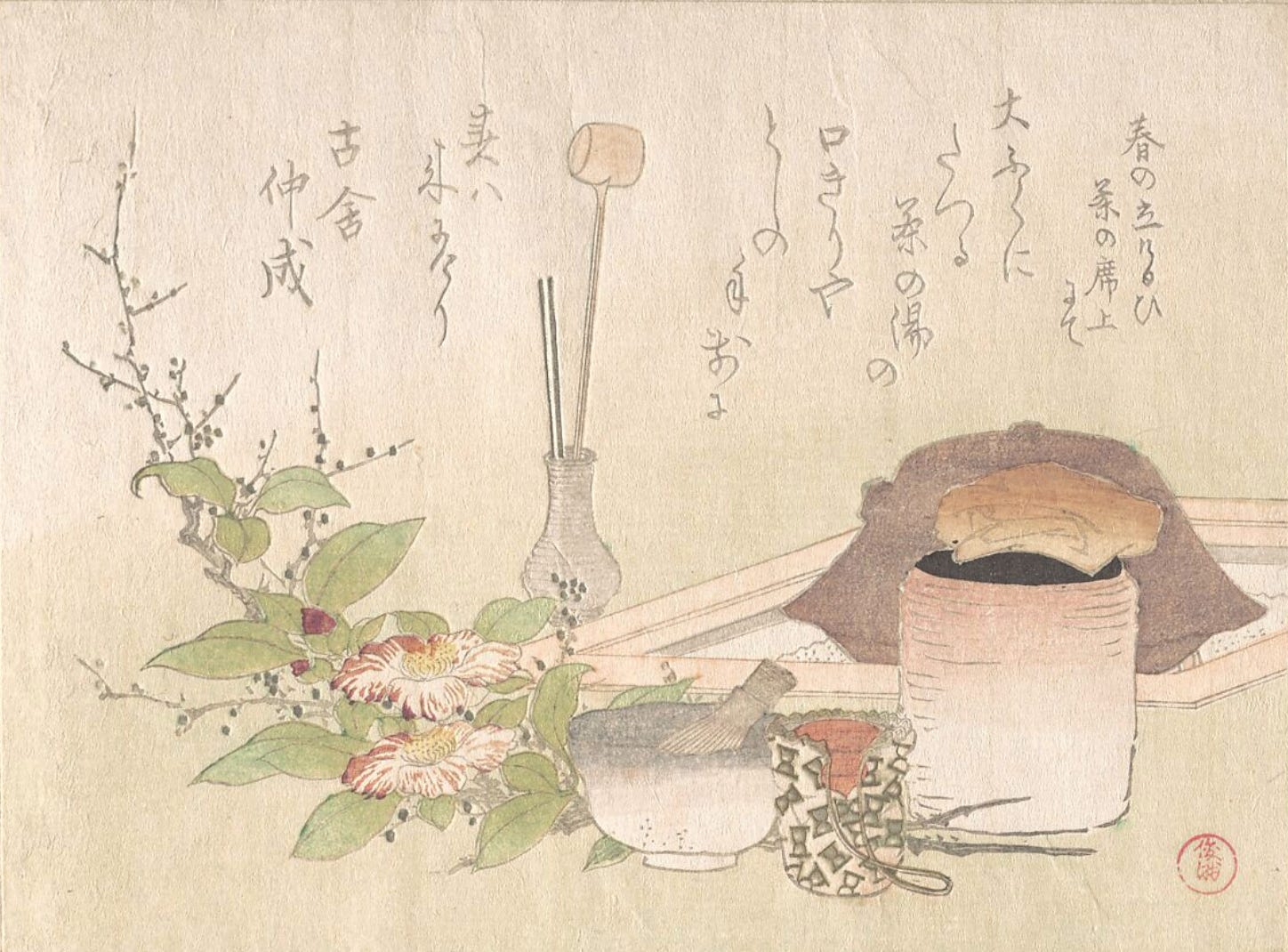
The tea ceremony was a part of this world, its aim to help people leave behind the cares and frenetic pace of everyday life and experience the preciousness of each moment.
The mandala helps us to see that while the tea ceremony is treated now as refined and highly structured - and not terribly relaxing as a result, if you participate in one - it was originally about letting go.
This is what I think modern Zen does so well, for all that it can sometimes appear confusing and even pretentious. It doesn’t deny the reality of the complex world we live in. But it takes the mandala and that journey inward seriously, helping us to spot the obstacles and offering support along the way.
Thanks for reading! As ever, if you’ve enjoyed this essay please consider liking and sharing. Since this is a paid post, you can share it by giving someone a gift subscription:
Image credits:
Mandala: British Museum.
Set of utensils for the tea ceremony: The Met.
Excellent post ... thank you Christopher ...