


Join me in January for The Good Life in Japan: an online course exploring how, across 1,000 years, Japan has been asking and answering the question of how we can live well.
We’ll explore Japan’s major cultural traditions, including Shintō and Buddhism, and you can either follow the course at your own pace or sign up for four weekly seminars led by me. The early-bird booking rate ends on Sunday 29th November, and subscribers to Japan and the World receive a further discount:
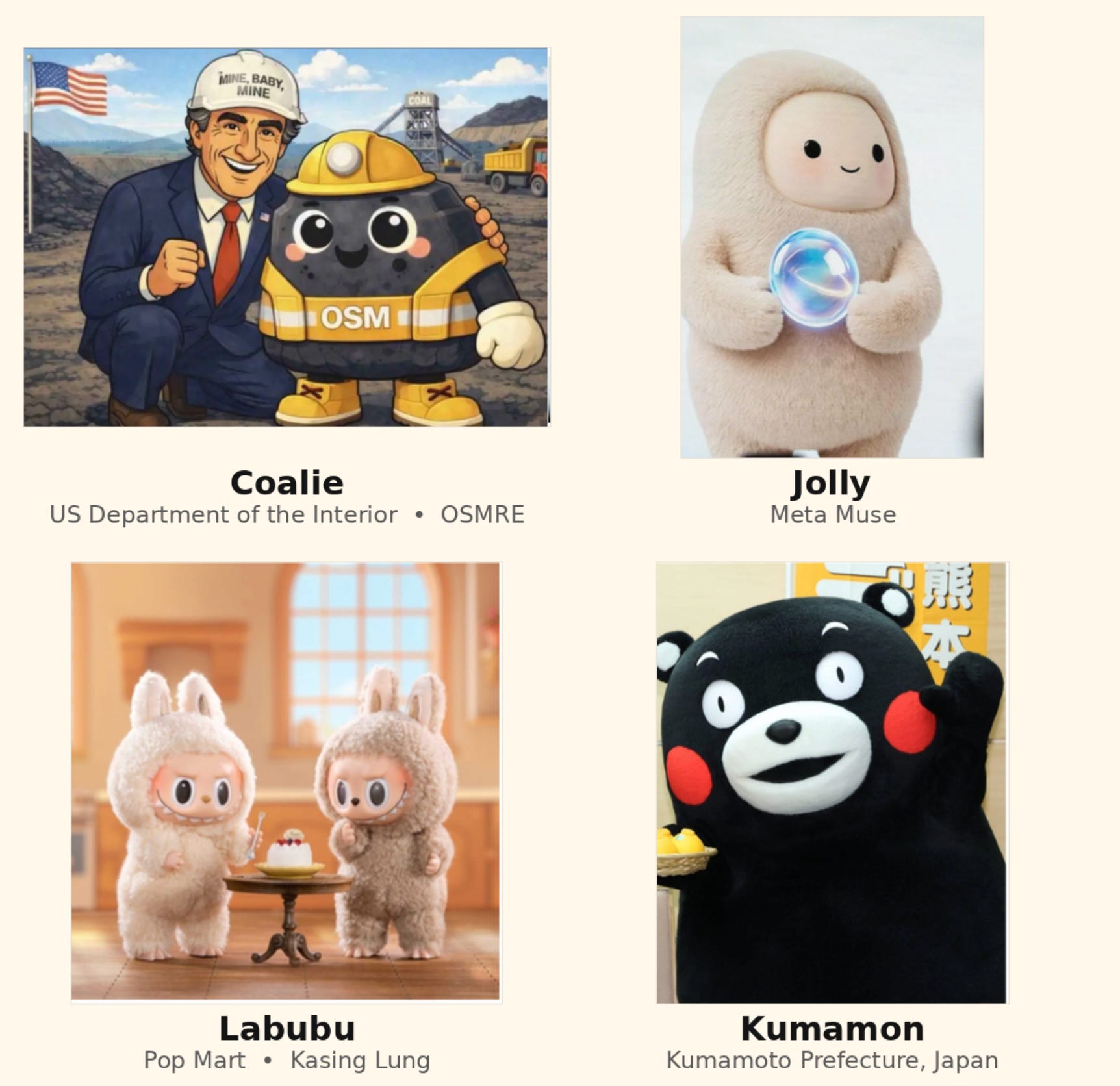
Meta’s new AI agent, Muse, launched in the UK this week, and it’s yet another example of a big institution leaning into Japan’s kawaii (‘cute’) aesthetic: big eyes, round bodies and soft colours - intended to be unthreatening, and to invite nurture.
But for all its global appeal, kawaii has its detractors. Why, critics wonder, do companies and government departments feel the need to create childish characters in order to get their messages across? More broadly, why do so many Japanese girls still grow up hiding their intelligence and maturity in order to be less threatening company for men?
Venture further back into the Japanese past and you find very different idealised visions of femininity: shamans, queens, goddesses, military leaders poets and political strategists.
Now that kawaii has gone global, perhaps its relative value in Japan will decline and this cultural moment will fade. In the meantime, there is one aspect of it that I think carries real value: it is serious - very serious - about play.
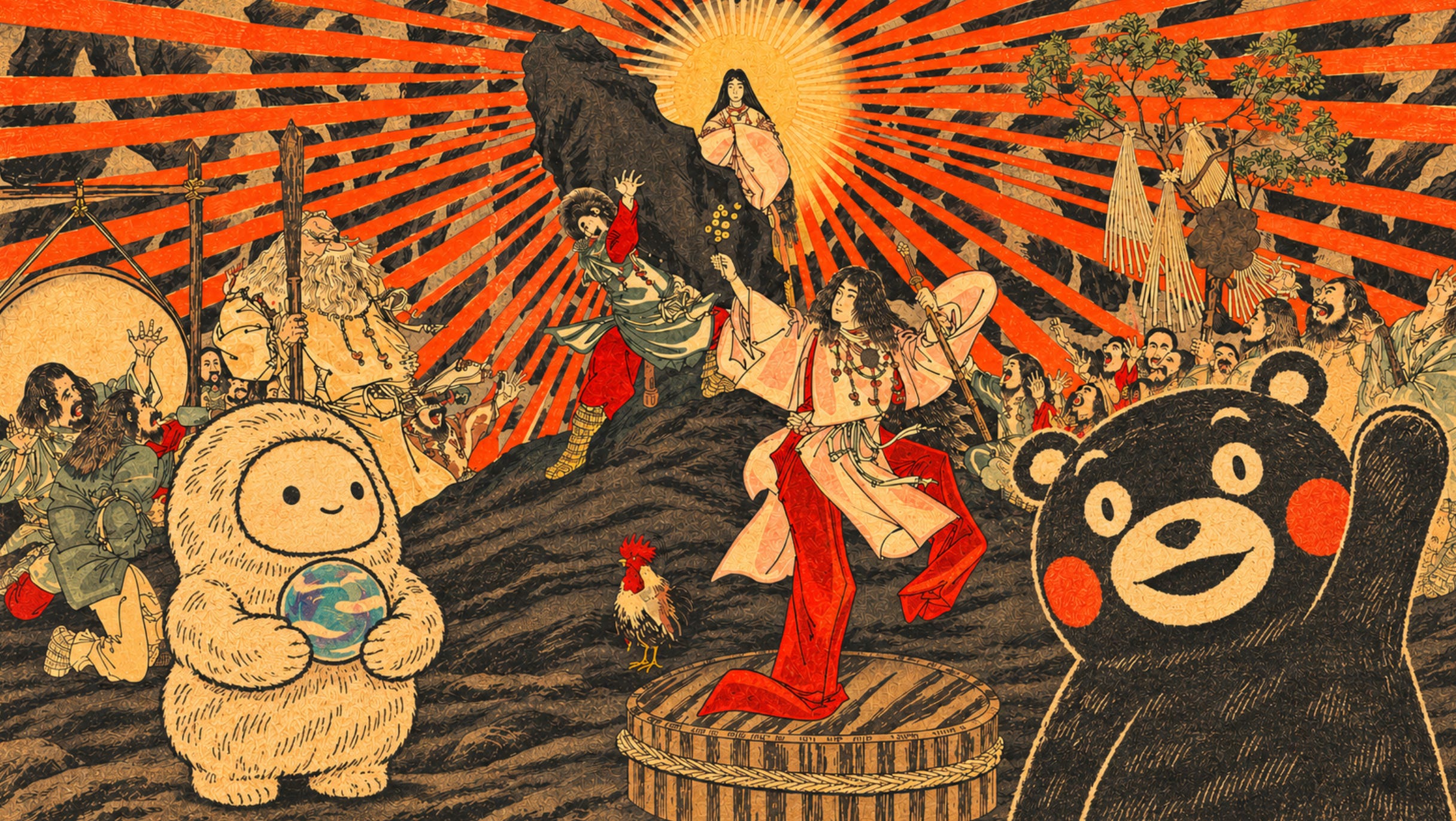
Depending on where you’re reading this, the nights may be drawing in or the days getting longer. Either way, it’s not a bad time to get acquainted with one of the greatest figures and stories in all of Japanese mythology: the sun goddess Amaterasu and the story of the cave, first committed to writing back in the early eighth century, in a text called the Kojiki.
One version of the story begins with atrocious behaviour by Amaterasu’s brother Susanoo, the Storm God. She becomes so angry at him that she hides herself away in a cave, casting the world into cold and darkness.
In countless cultures, the reaction to a disaster like this would be prayer, solemn ritual and a never-ending series of devotional acts bordering on begging.
Not in Japan. Here, alongside offerings and invocations, the gods gather around the cave-mouth - and play.
The Goddess of Mirth and Dawn jumps half-naked onto an upturned tub and performs a bawdy, ecstatic dance. Others bang drums, crash cymbals, play music and bring along animals to raise the noise levels. Everyone ends up falling about laughing.
Amaterasu hears all this from inside her cave, and curiosity eventually gets the better of her. She pokes her head out to see what’s going on, and the Strong-Armed Man of Heaven hauls her fully into the open. Light and warmth are restored to the world.
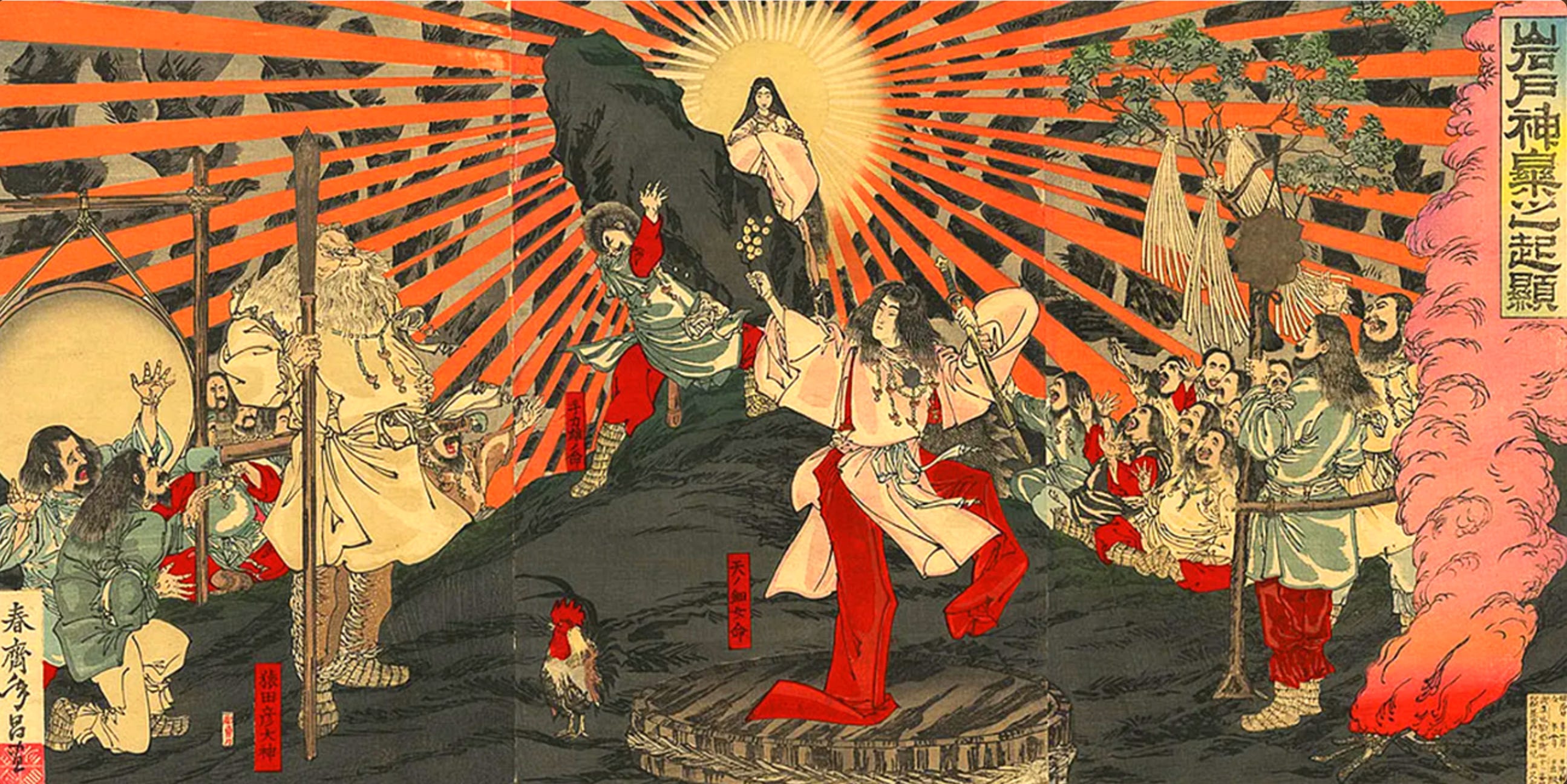
Woodblock print, 19th century, Shunsai Toshimasa
Down the centuries, there have been commentators in Japan who regard this story as a real event in history. Others have understood Amaterasu as a manifestation of a Buddhist deity named Dainichi Nyorai - the cosmic Buddha whose most famous representation in art is the 15-metre gold-covered statue in Tōdai-ji temple, in Nara. Still others have connected the sun goddesses’s act of hide-and-seek to agriculturalists’ experiences, since time immemorial, of changing seasons.
One of my favourite interpretations of the story is that play in Japan - asobi - can be sacred. We find proof of this in a Shintō ritual known as kagura, which involves music, dancing and play for the rejuvenation - at various points in history - of the emperor, warlords and the nation as a whole. People also dance to pacify spirits. Beyond Japan’s modern reputation for a punishing work ethic lies this older, deeper commitment to play.
If play is capable of cosmic consequences, then it must in some way be a deep feature of reality.
Morality, purpose, rational understanding: all these things are valued in Japan. But sometimes ‘knowing’ something is less about grasping it intellectually than participating in it. If you’re in a choir, enjoy jokes, do sport or make things, you’ll see this right away. Trying to explain any of these activities, as opposed to engaging in them, is obviously second-rate.
The same is true of play. Try interrupting a child’s game to ask whether they’re picking up motor skills and enhancing their social awareness. Or an adult on a football pitch whether they’re feeling rested and energised now, ready to get back to work on Monday. Play doesn’t have to be ‘for’ anything; it’s a deep and satisfying form of knowing and enjoying the world.
Nor is this an insight limited to Japan. In India, Shiva dances and Krishna plays the flute. The Greek philosopher Heraclitus talks about Eternity as ‘a child playing.’ For Plato, human beings are playthings of the gods - and so we must learn how to play.
Kawaii culture can feel worn-out and cynical - witness the outcry over the AI-generated ‘Coalie’, pictured above, used to extol the virtues of mining. But to the extent that they retain some power to generate in us a playful spirit, I think I can put up with cute mascots and furry toys for just a little while longer.
—
Thank you for reading! We’ll be learning more in January about Japanese myths and gods, Zen Buddhist art and practices, and Confucianism’s ideas about living well together. I hope you’ll join us! ⬇
—
Further Reading
Joy Hendry and Massimo Raveri, Japan at Play: The Ludic and the Logic of Power (Routledge, 2002)
Johan Huizinga, Homo Ludens (1938)
Images
Meta Muse’s ‘Jolly’: Mashable (fair use)
Kumamon: The Japan Times (fair use)
Coalie: Wikipedia (public domain)

Labubu: Wikipedia (fair use)

Amaterasu woodblock print, 19th century, Shunsai Toshimasa: Wikipedia (public domain)
