


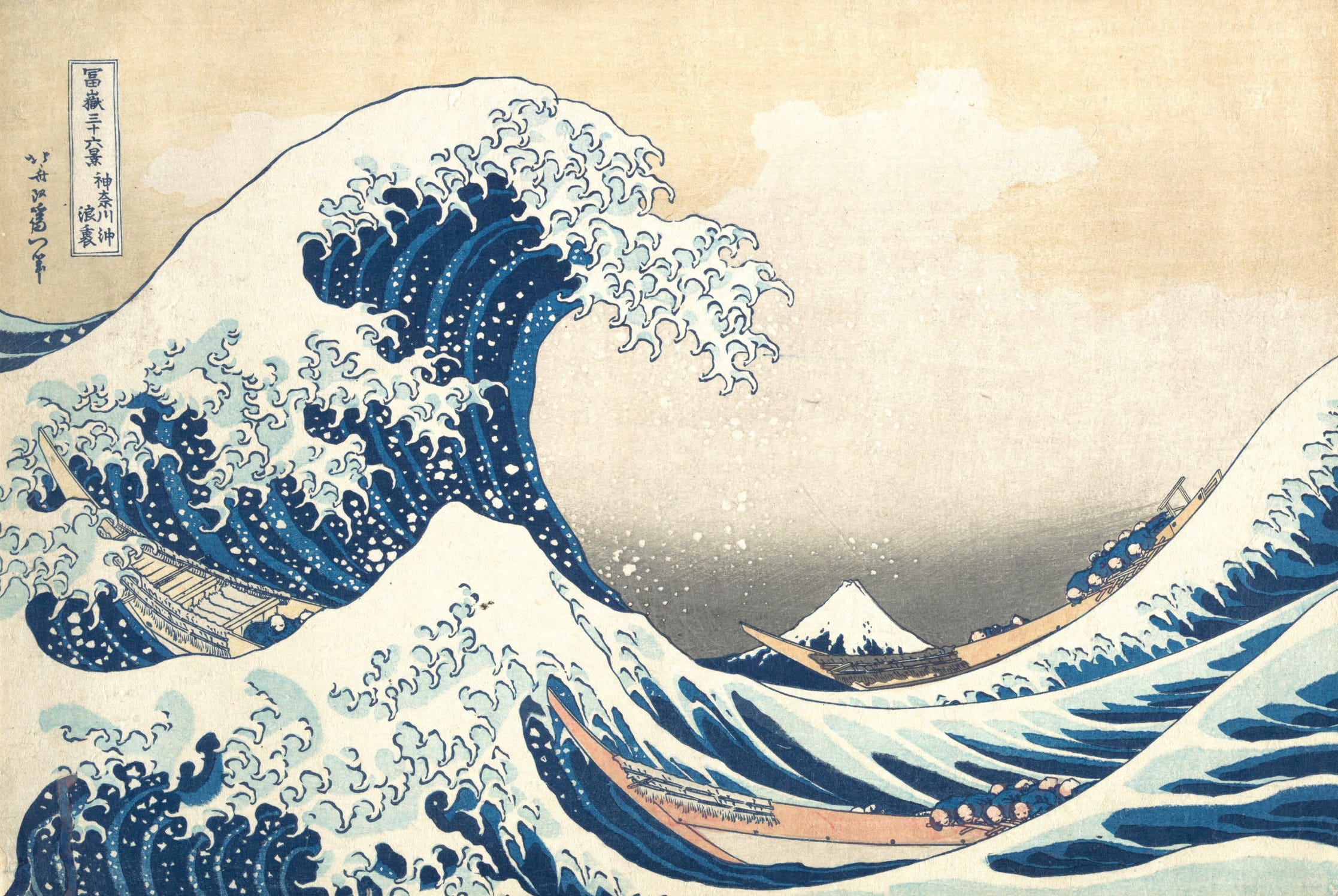
Late last year, a woodblock print which in its own day would have cost you about the same as a bowl of noodles sold at Sotheby’s Hong Kong for a cool $2.8 million.
There seems to be no stopping this iconic image: ‘The Great Wave off Kanagawa,’ created by Katsushika Hokusai and included in his series Thirty-Six Views of Mount Fuji (1831). You’ll find it now, in Japan, on manhole covers, on banknotes, and in exhibition after exhibition. It’s on towels, tins, cups and chopstick sleeves. There’s a LEGO set, and beyond Japan it’s one of the most requested tattoos.
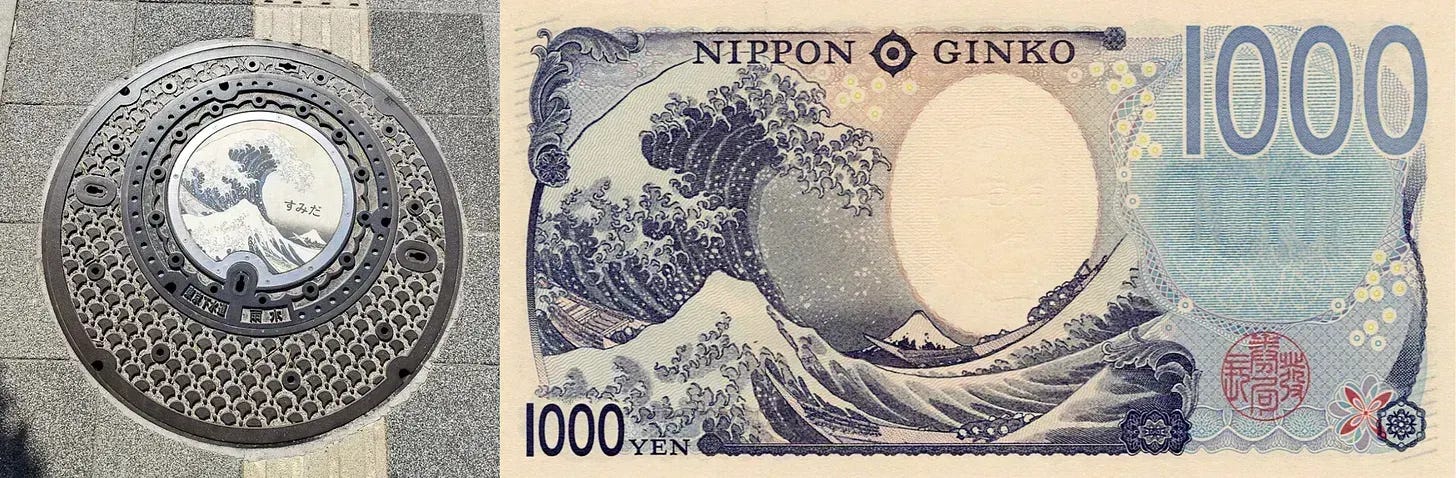
How did this happen? The Thirty-Six Views were a hit in Edo soon after publication. But ‘serious’ Japanese artists looked down on the likes of Hokusai, as mere tradesmen.
Hokusai responded - claims a late 19th-century account - with a certain outsider swagger. One story has him going head-to-head in an art competition organised by the shōgun himself. His opponent, Tani Bunchō, was a highly-regarded literati painter.
Hokusai’s effort that day was insultingly simple. He drew a single blue curve, let a chicken with vermillion-painted feet run across the paper, and declared that he had drawn maple leaves on the Tatsuta River in autumn.
It may be apocryphal - but we’d all love it to be true.
Legends can also be found surrounding The Great Wave’s rise to international fame and glory. In 1856, a French etcher named Félix Bracquemond supposedly discovered an edition of Hokusai’s Manga sketchbooks being used as packing material around some imported porcelain. From there - or perhaps for different reasons entirely - Paris went wild for Japanese woodblock art, and later for Hokusai in particular.
In one respect, The Great Wave was global from the outset. Hokusai created it using an imported pigment called Prussian Blue. But the image’s reception in Europe was what helped to make its name right around the world: praised by Van Gogh for its claw-like wave; featuring on the cover of Debussy’s La Mer; inspiring countless later artworks.
Icon though it now is, both in Japan and internationally, The Great Wave is not read in the same way at home in Japan versus much of the western world.
The crucial difference, as the artist Carl Randall told me a little while ago, lies in the direction in which people read text.
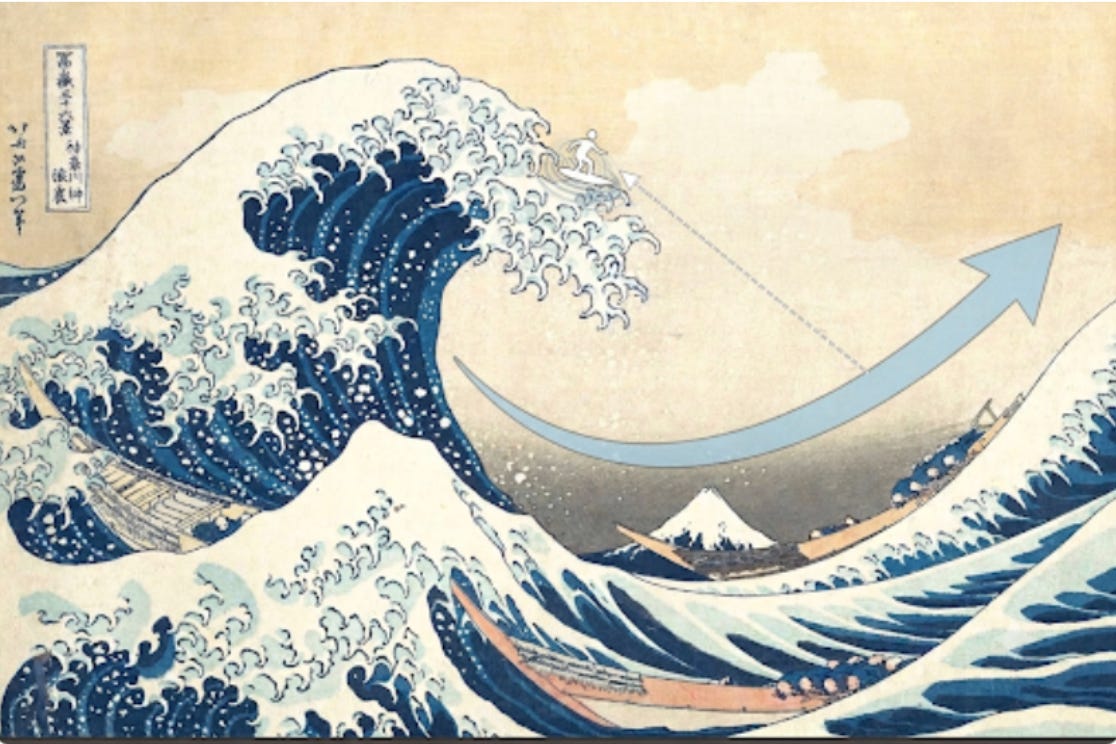
In English, we read from left to right. This affects how we ‘read’ an image like The Great Wave. The eye naturally moves rightwards, so it feels as though we are travelling with the wave. We’re surfing it.
In Japan, people read in vertical columns from right to left. To read The Great Wave in that direction makes it feel as though you’re travelling into the wave - about to be engulfed by it, submerged, while Mount Fuji looks serenely on.
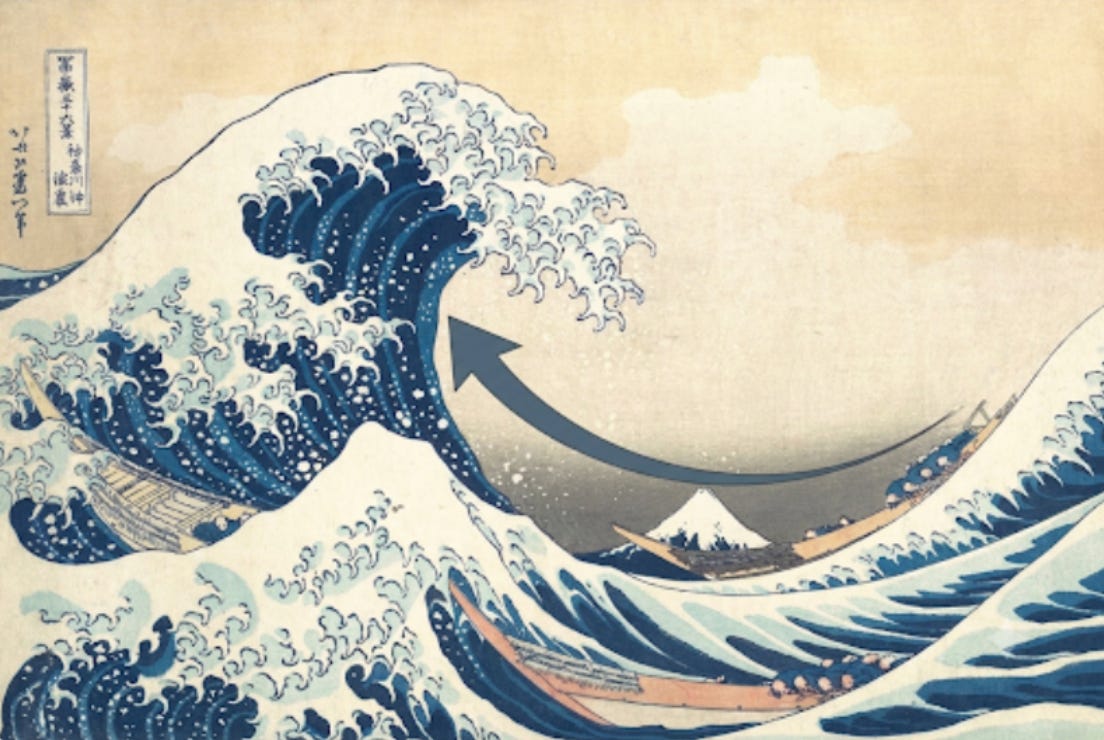
The Japanese reading points us more towards human drama: it emphasises the perspective of the people in the boats, in fear of being overwhelmed. To read from left to right makes the image - to my mind, at least - more about nature’s relentless momentum, and its indifference to us puny humans.
Whose side, you wonder, is Mount Fuji on?
Japan and the World will be on its summer holidays for the next two weeks, returning on Friday 14th August.
—
Images
Hokusai manhole cover: Sora News (fair use).
This is a fine insight. We should have both perspectives in mind to fully appreciated the power of this print.
Now that I know about the different ways to read it, I prefer the Japanese way. I have a poster of it hanging in my hallway. I will never look at it the same without having my heart skip a beat. I used to think of it as just a beautiful painting. Now I feel it is heading to engulf me as I sit in the boat, knowing I am about to drown!