


When someone says ‘samurai,’ what do you think of? Armour? Swords? Bloodshed?
All true enough, but a much-underrated part of the samurai image is the inveterate social climber. You start to see it in the era of the Kamakura shogunate, once the samurai began their centuries-long dominance of Japanese life following a civil war in 1180-85.
Court nobles had been the big cultural sponsors and entrepreneurs up until this point. But across the thirteenth and fourteenth centuries, we find high-ranking samurai joining them. Keen to overcome their low status as men of violence - which was how Kyoto high society regarded them - they became increasingly involved in pursuits like painting, calligraphy and the pioneering of new forms of theatre like Nō.
Zen Buddhist priests contributed, too, to this emerging cultural moment. Many had strong contacts with China and Chinese culture, and were accomplished artists and connoisseurs.
One of the places you’ll find this shift most vividly on display is in the look and feel of Japanese gardens. The entertainment gardens of the past didn’t entirely disappear. But they were joined by gardens that looked like Chinese landscape paintings brought to life in abstract form, often employing a karesansui (‘dry mountain water’) style: using raked sand or gravel to represent still or flowing water.
The focus now was less on entertainment and more on contemplation. Ponds, if used at all, tended to be smaller: their purpose was to contribute to an atmosphere of serenity, not to encourage people to carouse aboard a boat.
A prime example of one of these ‘Zen gardens’ can be found at Ryōanji temple in Kyoto. Fifteen stones are set amidst raked white sand, each placed in such a way that from any given angle only fourteen will be visible - except from above of course, but medieval Zen gardeners weren’t thinking much about birds and had never heard of drones.
People have been asking the same question about this garden for 500 years: why design it so that one stone always obscures another? Some say that the stones represent islands of consciousness within a larger emptiness. The garden’s purpose is to help us see that no single point of consciousness – yours, mine, or anyone else’s – can ever apprehend reality in its fullness.
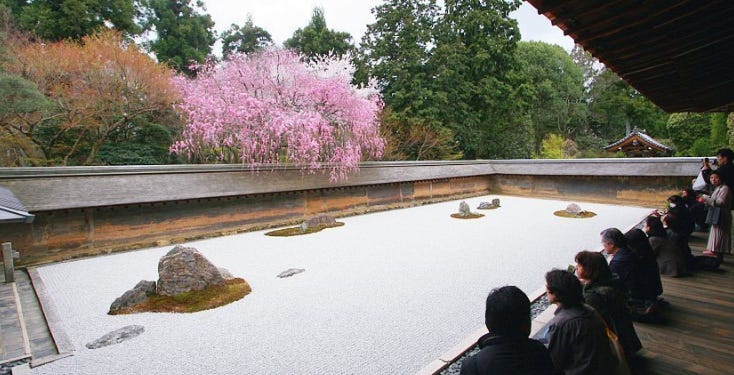
Visitors to Ryōanji sit on the deck of the main temple building, grappling with the garden’s possible meanings...
Warriors who didn’t want to walk to a temple to appreciate a well-crafted garden could have some of their juniors create one in the spaces around their homes. Some were in the newer Zen style; others resembled the entertainment gardens of the past - yet another way of claiming Japan’s aristocratic heritage for themselves.
The ancient principle remained strong, right through the Edo period and into the modern era, of representing grand natural landscapes in miniature - mountains, streams, shorelines. If you go to Japan now, you might see echoes of this in courtyard gardens known as tsubo-niwa - used to bring a little class and good cheer to homes, cafés, hotels and restaurants.
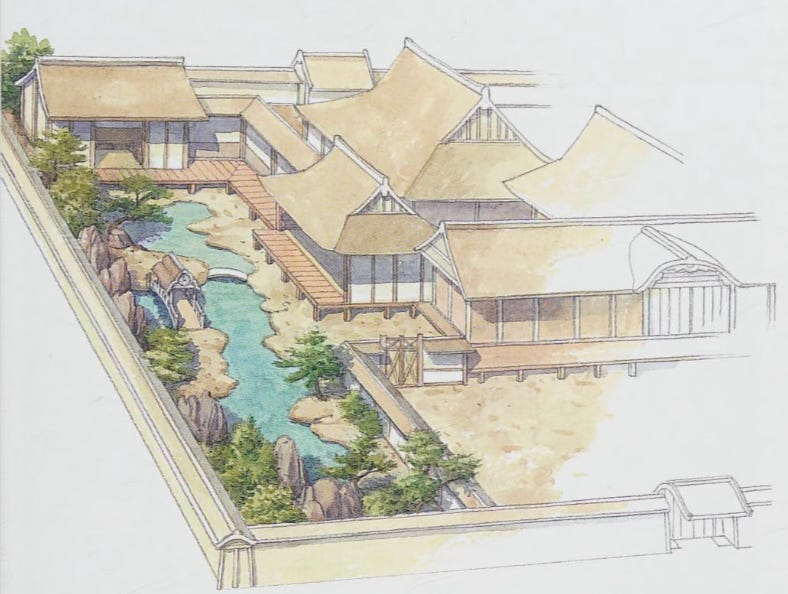
A warrior garden, designed to fit between buildings and compound walls.
Where tsubo-niwa emphasise the private enjoyment of nature, cherry blossom season brings people together - in celebration of a moment whose energy comes, in part, from the fusion of two very different forces in Japanese culture: Shintō and Buddhism.
Shintō celebrates life, including new life. And it’s hard to imagine a more immediate and vivid sign of new life than white and pink cherry blossoms bursting forth from previously barren branches. Buddhism’s reputation for gravity and grimness is meanwhile a little overdone, but it does place enormous emphasis on impermanence. And nothing says ‘impermanent’ quite like the sight of cherry blossoms falling to the ground and withering away.
The varied emotions that the cherry blossoms inspire across their life-cycles are unified in mono no aware: the capacity to appreciate and be moved by the passing of all things into and out of existence.
Trust a poet to put it best - here’s Ono no Komachi, a celebrated yet mysterious female poet of the ninth century:
The colour of the blossoms
has faded.
In vain
Have I passed through the world
While gazing at the falling rains.
Cherry blossoms have served as powerful symbols in Japan across the centuries since, from cherry blossom-viewing as a mass seasonal event from the Edo era onwards to their use in World War II as a way of justifying and extracting maximum propaganda value from the deaths of young Japanese in combat.
A manga translator once told me how helpless she felt when a single frame at the start of a story featured cherry blossoms. Readers of the Japanese original would immediately connect with the intended mood, meanings and associations. But how do you conjure that in text for western readers, with virtually no space to spare on the page?
That problem is surely easing, now, with cherry blossoms going global as one of our major associations with ‘Japan.’ With that in mind, if you’re near London and want to avoid the ‘plague’ of Instagrammers descending on places like Notting Hill, I recommend a visit to the Kyoto Garden in London’s Holland Park - opened back in 1991 by two young princes, now King Charles III and Emperor Naruhito.
Here are some features to look out for:
The cascade. If you’ve read Part I of this two-part series, you’ll know why the garden’s designer, Shoji Nakahara, had to locate this remarkable water feature in the north-east, with the outflow of the pond in the south-west. The pond is a lovely example of a ‘borrowed’ feature, suggesting a sea with a rocky shore, backed by a mountain - from which the waters of the cascade pour down.
The bridge over the pond is staggered, lending it more interest and ensuring that evil thoughts - believed to travel only in straight lines - fall harmlessly into the water, rather than reaching the tea-house that would often be the final stop in a garden like this.
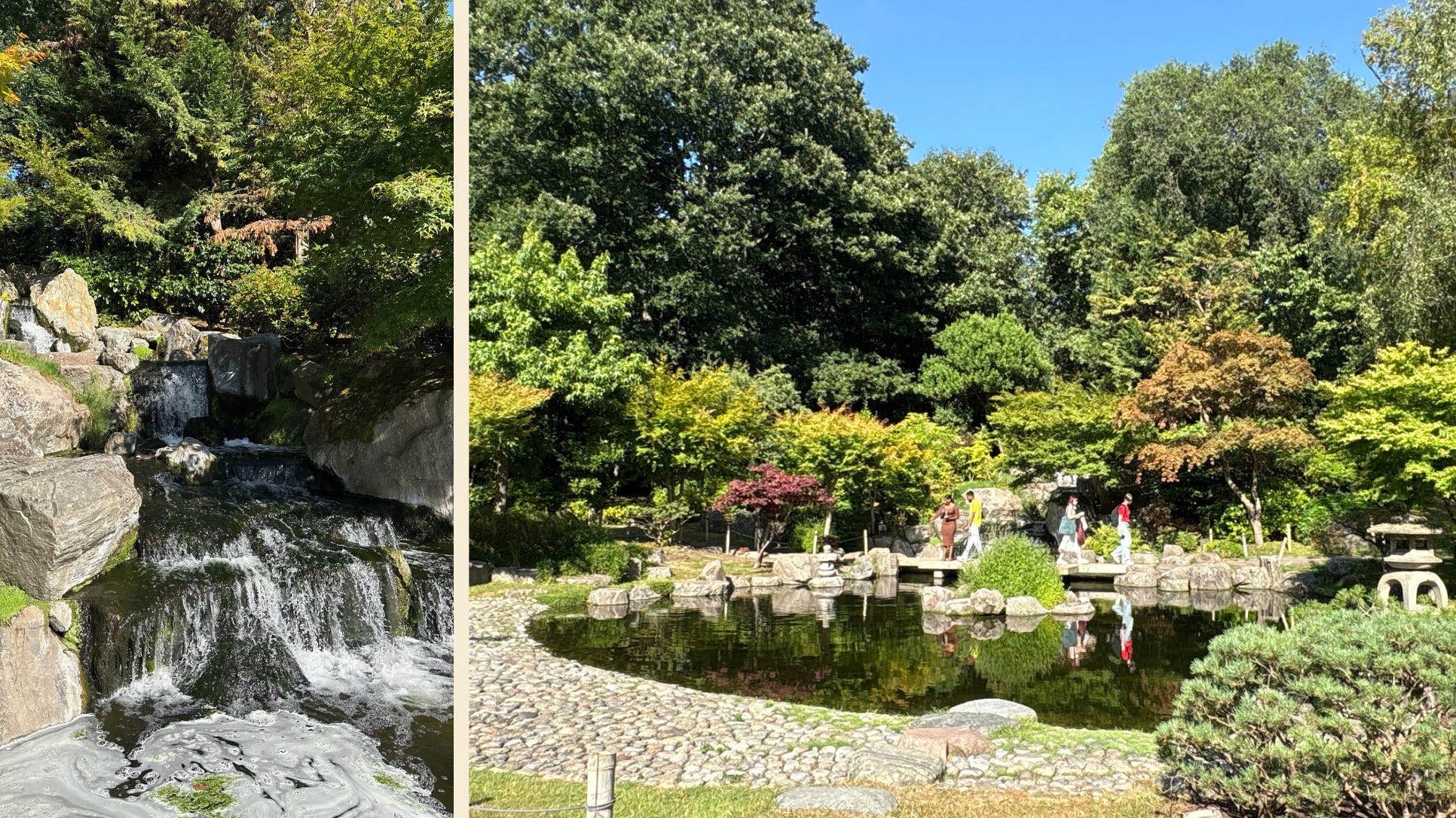
London’s Kyoto Garden
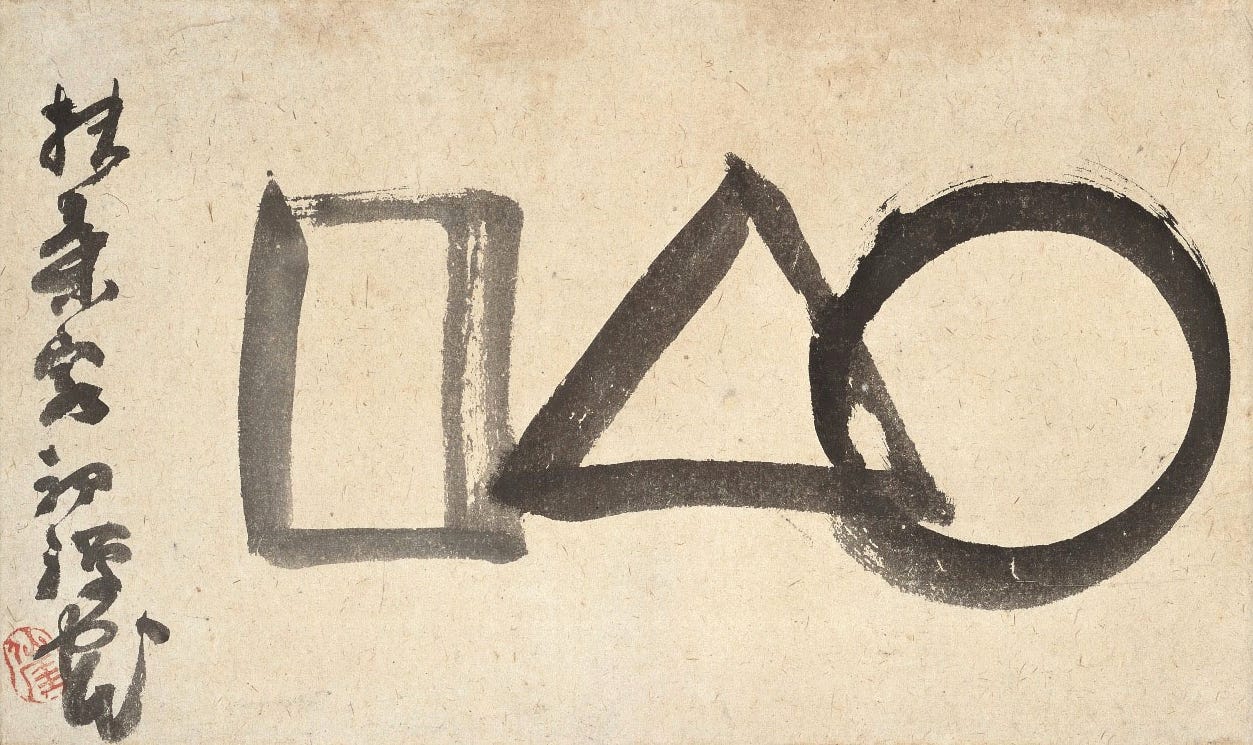
The well in the garden is square rather than circular, hinting at a famous zenga (zen picture) called Marusankakushikaku (‘circle-triangle-square’) by the Japanese monk Sengai in the early 19th century. It is said to be a representation of everything in the universe in three simple shapes:
Embedded pebbles bordering some stepping stones. It wasn’t supposed to be this way! The garden originally had moss, but the public found it so easy to walk on - compared with the stones - that the moss wore away. The pebbles were the solution.
Noise! Again, it wasn’t supposed to be this way, but the idea of what a garden is for differs a little in Japan versus the UK. Various solutions have been tried to keep things calm in Kyoto Garden, including ropes, signs, notices and gardeners doubling as security guards.
‘Cloud pruning’ of the Japanese maples and other features of the garden: intended to suggest floating clouds.
Koi (carp): capable of bringing colour to all kinds of Japanese gardens.
Thank you for reading - feel free to like (via the heart button) and share!
—
Images
Ryōanji: Japan Guide (fair use).
Warrior garden: illustration featured in David & Michiko Young, The Art of the Japanese Garden (fair use).
Kyoto Garden: author photographs.
Marusankakushikaku: Wikimedia (public domain).

Thank you Christopher, enjoyable to read this deciphering of gardens beneath the surface