


Enrolment opens today for my first online course, The Good Life in Japan, and for a live History Evening on How to Read Japanese Art. Details, and a readers’ discount, at the end of this post.
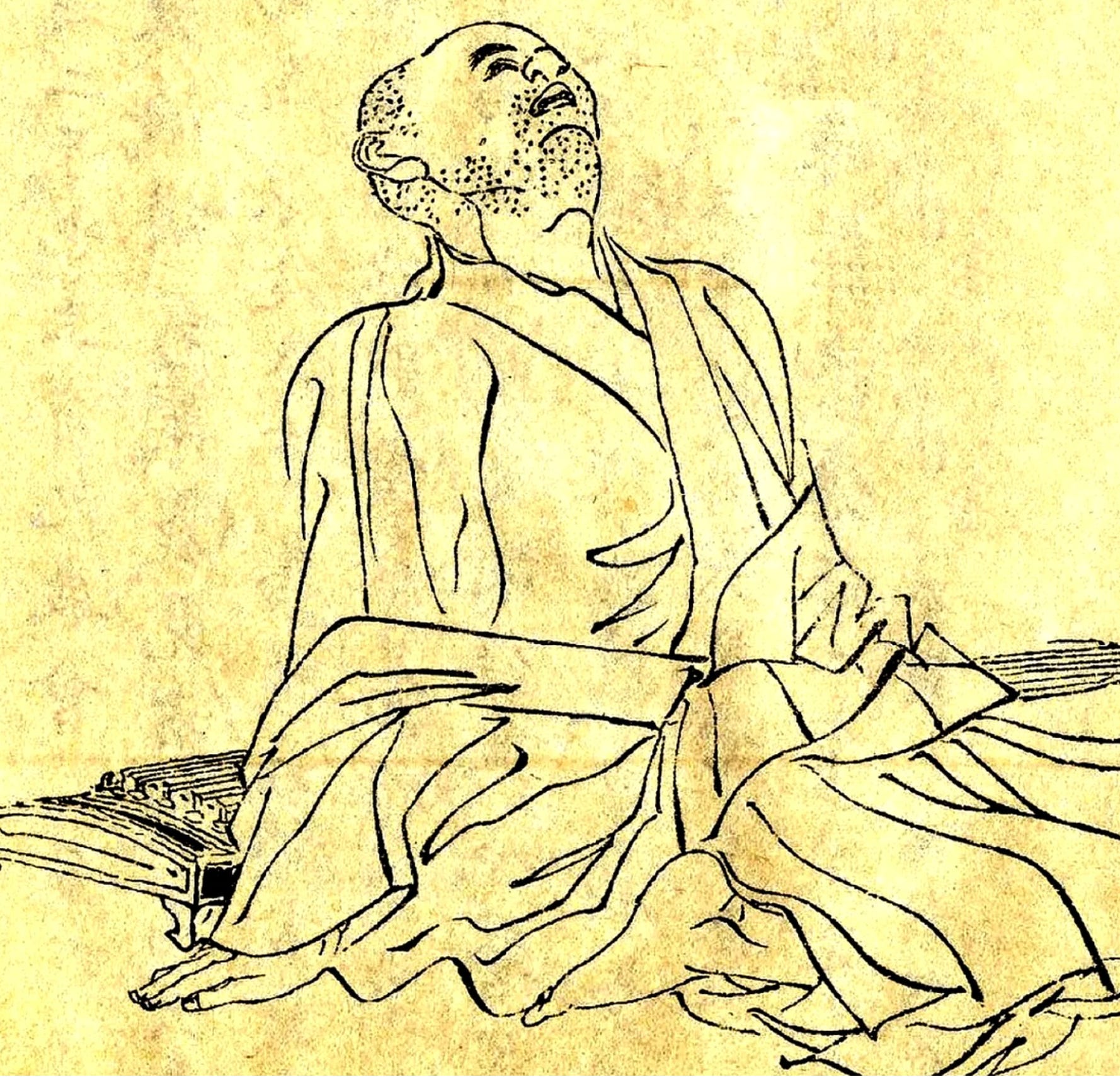
When I reached the age of sixty, and the dew of life had disappeared,
I built a hut to be my final refuge.
… an old silkworm spinning his last cocoon.
By the close of his sixth decade, the poet and essayist Kamo no Chōmei (c. 1153 - 1216) had seen more than enough of life. His father, a priest at Kyoto’s prestigious Kamo Shrine, had died while Chōmei was still in his teens. Chōmei had been passed over for promotion. And then nature itself had rebelled.
In one of the great works of Japanese literature, Hōjōki (1212), Chōmei describes fire engulfing Kyoto, destroying some of the city’s grandest imperial buildings. Next came a whirlwind - flattening homes, ripping up gates, sending stone walls crashing to the ground and great plumes of dust into the sky.
Famine followed, after a harvest failed. People began descending on nearby temples: some to pray for relief, others to help themselves - stealing statues to exchange for food. Chōmei found firewood for sale that was painted in rich temple crimson and flecked with silver and gold. Aristocrats were seen touring the city in their finery, tiptoeing around corpses and knocking on doors to beg for help. Finally, a series of earthquakes arrived. ‘Mountains crumbled… seas heaved… the ground split open.’
Alongside nature’s revolt ran the steady corruption of society. Kyoto had always had its fair share of crime. The difference, from the mid-twelfth century onwards, was that heavily armed and highly trained bands of men from out in the provinces were starting to fight running battles with one another in its streets. A world of fine food and manners, poetry and scented love letters was deteriorating into anger, fire, and severed heads stuck onto spikes around the city.
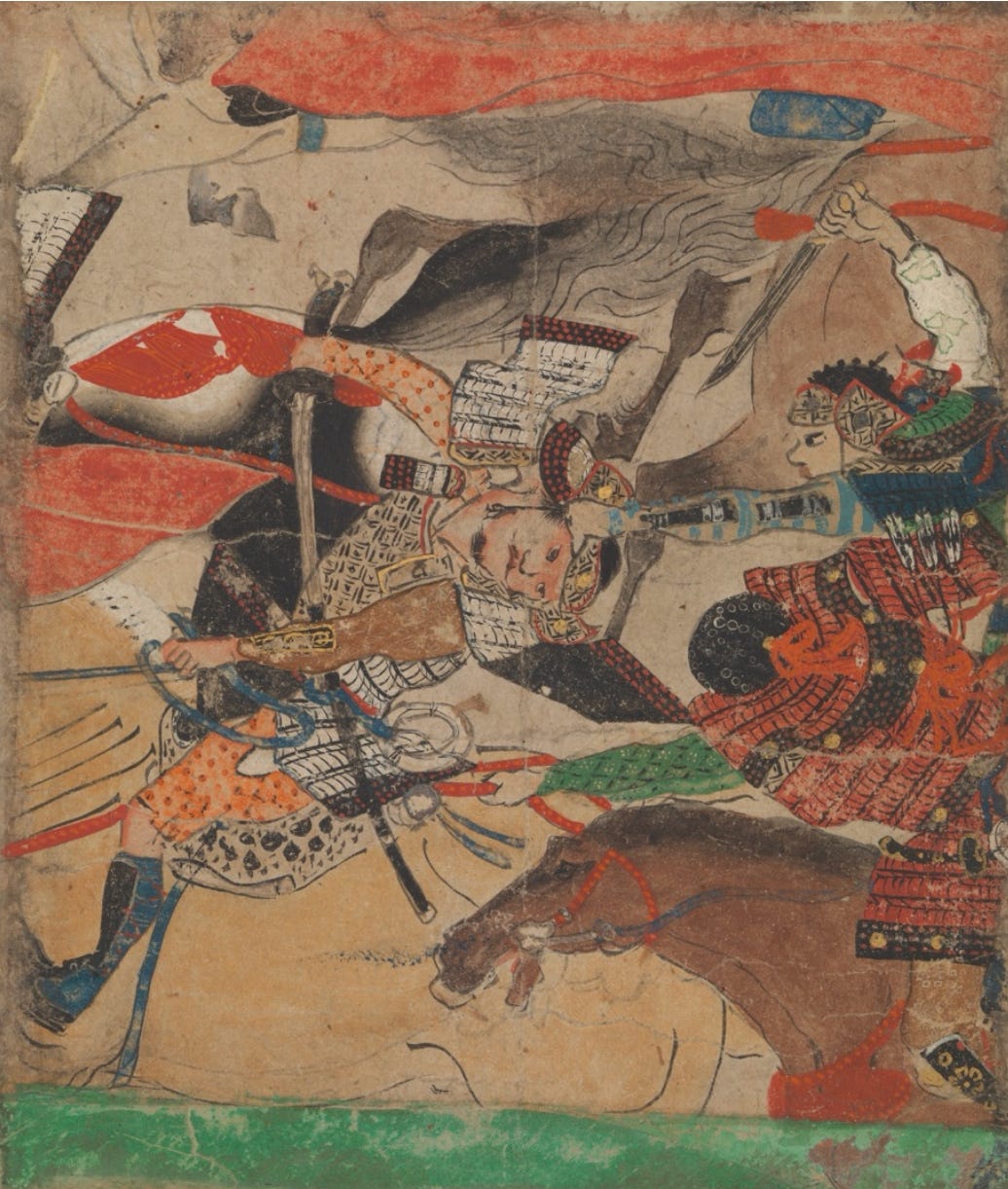
Violence on Kyoto’s streets: ‘Battle at Rokuhara’, Heiji Scroll, early 14th century
This terrifying, profoundly disorienting sequence of disasters forced Chōmei to see with absolute clarity that nothing in this world is guaranteed, and nothing ever stays the same. He began to ask the biggest question of all: ‘where in this world should one live - and how?’
On some Christian and Japanese Buddhist readings, the world is supposed to be liveable and life is supposed to be fair. Only human wrongdoing, coupled with the mysterious workings of the divine, gives us a world that often looks like a failure. Nor are we powerless to make things better. The exercise of love and compassion can help restore things to their intended state.
Chōmei didn’t see it this way. Shaped by the ‘Pure Land’ branch of Buddhism in responding to the turmoil both around and within him, he concluded that as human beings we cannot live without depending on something or someone. The wealthy, Chōmei reflected, depend on their status. They live in fear of its burdens but also of its fragility. The poor depend on those around them, living out their lives in shame and bitterness. All depend on a basic constancy in life that simply isn’t available.
So what do we do about it?
Chōmei’s answer was to try to cut down on his dependencies. Unmarried, and with no children, he exchanged his home in Kyoto for a tiny thatched hut in some nearby hills. Just three metres long and wide, it was intended to serve as a practical experiment in non-attached living. Too many of the people Chōmei knew back in Kyoto built up their homes, just as they built up their lives: as a doomed attempt to gain approval from others.
And yet readers of the Hōjōki soon find Chōmei’s experiment going wrong, as he morphs from ragged recluse to proud homeowner. He describes his awning, bamboo duckboard and image of Amida Buddha - this last looks especially beautiful, he writes, when bathed in the evening sun. He has black leather-lined baskets set out to store his poetry and music, alongside a lute and a Japanese zither. His writing desk sits under a window.
Chōmei, it seems, has brought much of his old life with him.
Nor is this a life of harsh self-denial. Depending on the season, Chōmei has wisteria, cuckoos and cicadas for company. He sings and plays his instruments, and now and again goes on walks with one of his neighbours. They pick flowers, gather nuts, admire fireflies and mingle with mountain deer.
This isn’t truly independent living. It’s the exchange of old dependencies for new ones. And yet this seems to be Chōmei’s message. It isn’t in our power to live with total independence. What we can do is reorder those dependencies.
Chōmei’s new dependencies are, by their nature, fleeting. Seasonal sights, sounds and foods; brief encounters with this or that creature. Transience turns out to be something you can truly depend on.
This is a beautiful idea - but I think it comes with risks.
The Hōjōki begins with an image familiar to fans of Western philosophy: a river never stands still; change is a deep feature of reality. It’s tempting to respond to this insight by living life sitting on the riverbank, watching the water go by - never diving in, for fear of turbulence and loss.
Better, but harder, is to fully engage in life - love, purpose, joy - without clinging to it or trying to possess the people and things involved.
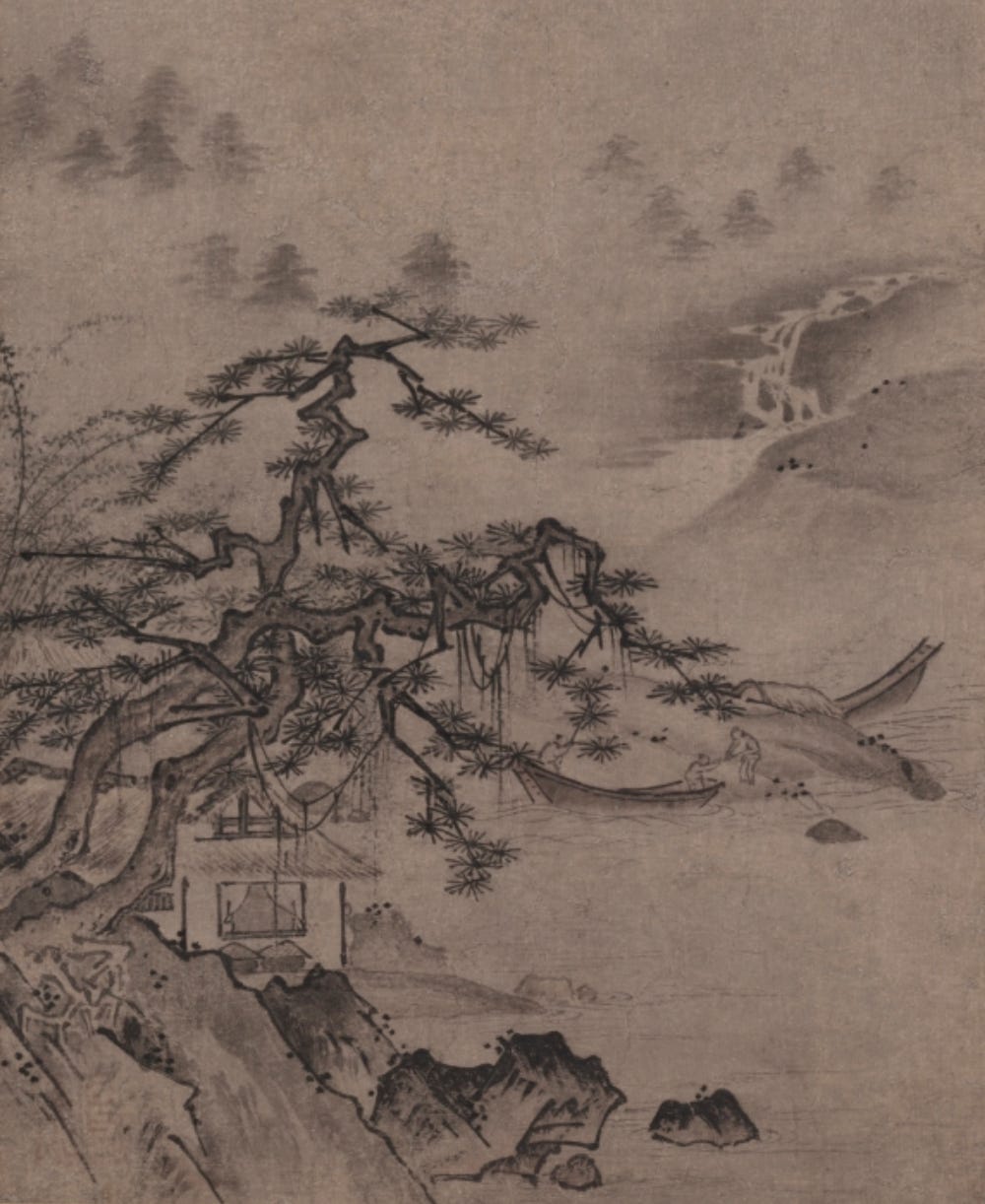
‘Thatched Hut by Water’s Edge’, circa 1500 - 1573: an idealised scholar’s retreat
It’s possible to read Hōjōki as an experiment in precisely this kind of living. For all that critics might regard Chōmei as remaining every inch the Kyoto courtier - with his lute and his literary references (Hōjōki is packed with them) - he seems to integrate these pleasures and sensitivities into his new, simpler surrounds. He becomes more responsive to the world.
He may even, at last, be flourishing.
*
Come and puzzle this through with me! On 18th January, I’ll begin a 4-week online course on The Good Life in Japan. In the company of Kamo no Chōmei and a host of other deep thinkers and big characters from across Japanese history, we’ll be asking - and trying to answer - a version of Chōmei’s great question: what does it take to live well - and what might it cost us?
Each week features three short video talks, optional readings from an illustrated handbook and access to a discussion forum. You can follow the course in your own time or apply for a seminar place, joining me in a group of no more than eight people for four weekly discussions.
As a thank-you to readers of Japan and the World, your subscription gets you a discount on the course. It’s applied when you book, as long as you use the same email that you use to subscribe to my newsletter. You’ll find details and an enrolment link here:
If January seems a long way off, come to my very first online ‘History Evening’ on 18th November. We’ll be exploring ‘How to Read Japanese Art’, and once again Japan and the World readers receive the same kind of discount. You can find out more here.
Thank you, as always, for reading. Please feel free to like, share and comment.
—
Credits
Ink portrait of Kamo no Chōmei, by Kikuchi Yōsai: Wikimedia Commons (public domain).

Battle at Rokuhara: Metropolitan Museum of Art (public domain).
Thatched Hut by Water’s Edge: Cleveland Museum of Art (public domain).
Excerpts from Hōjōki adapted from Matthew Stavros’s translation, in Hōjōki: A Buddhist Reflection on Solitude (2024).