


A parent returning home from a lengthy work trip is a moment of pure joy for children. The chance to be scooped up in your father or mother’s arms and given a long-awaited hug. The possibility of a present stashed away inside a suitcase - something fun and intriguing from a faraway place.
So pity the son of Ibuka Masaru. Across the 1950s and ‘60s, Ibuka made regular trips to the United States. He would return home with the very latest high-tech toys - and then, before his son’s sorrowful, disbelieving eyes, he would smash them, take them apart and fiddle with them to the point where they were impossible to play with.
Ibuka was not a sadistic father. He was an entrepreneur, learning from the best. Alongside Morita Akio, he served as a researcher in the Imperial Japanese Navy during World War II. At war’s end, the pair of them established a small electronics company called Tokyo Tsūshin Kōgyō - ‘Tokyo Telecommunications Engineering Company,’ or TTEC.
It was a grand name for a company whose HQ was a leaky shack and whose sole vehicle - and old Datsun truck - ran on black market petrol liberated from US Army stores. But Morita and Ibuka were determined to manoeuvre themselves to the forefront of what they were sure would be a resurgent electronics industry in peace-time Japan.
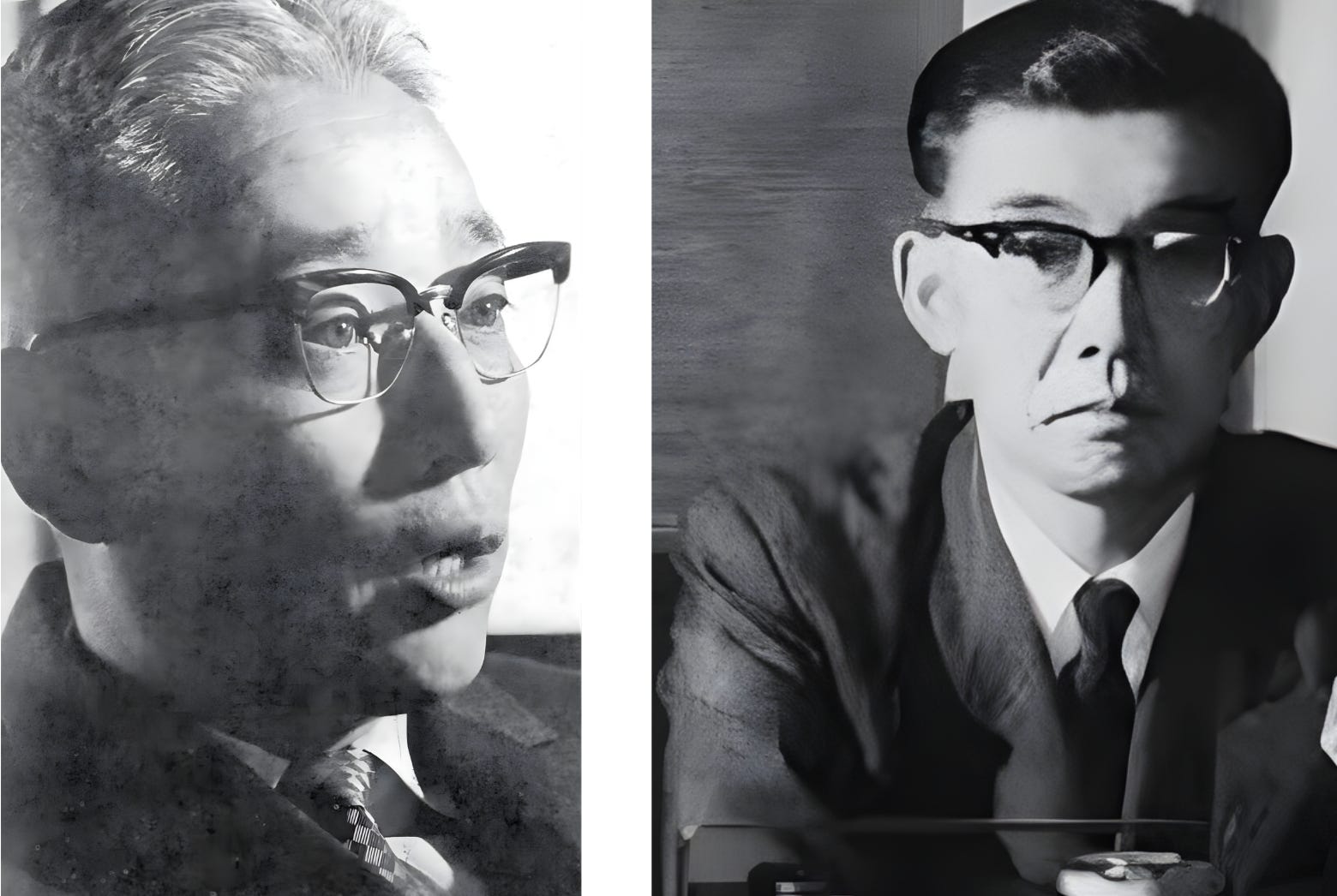
Left: Morita Akio. Right: Ibuka Masaru
Their first product was a tape recorder, which used magnetic tape made by frying yellow oxalic ferrite in a pan until it turned into brown ferric oxide. This was mixed with clear lacquer and then applied - using fine, badger-hair brushes - to hemp-strengthened craft paper painstakingly cut into strips with razor blades.
Morita and Ibuka were convinced that this was the technology of the future. Free speech was returning to Japan, and the national broadcaster NHK was encouraging the public to sing on the radio. Surely people would enjoy recording themselves on tape, then playing it back? Full of optimism, the two men loaded up their Datsun with TTEC’s pride and joy: a 35-kilogram tape recorder.
Sadly, potential buyers were unimpressed. The machine was huge, expensive and used too much power. A population still trying to recover a basic standard of living saw no pressing case for it.

Early postwar Tokyo
Even when TTEC whittled down the size of the new device to that of a bulky briefcase, the only buyers they could find were schools, currently being cajoled by American Occupation personnel into using more audio material in classes.
TTEC needed a miracle - and as luck would have it, one was being wrought at that very moment across the Pacific.
Thank you for reading! Please support my work by becoming a paid subscriber, and then read on for:
The miracle invention that saved Morita and Ibuka’s young company.
How Occupation politics nearly killed their prospects.
How an ingenious bit of advertising saved the day.
The hero of the hour, over in the United States, was no more than a few millimetres in diameter, and made from semiconductor materials. Its purpose was to amplify electronic signals – something that until now had only been possible with much larger and more energy-hungry vacuum tubes. An internal ballot at Bell Laboratories to decide on a name for the new invention was won by the word ‘transistor’.
In 1952, while on a sales visit to New York, Ibuka discovered that a manufacturing licence was now for sale. TTEC would buy it.
But it wasn’t that simple. One of the few corners of the Japanese establishment more or less untouched by Occupation reforms was the civil service. Its staff were, the Americans concluded, essential for running the country. They ought to be given fresh instructions rather than simply let go.
In this way, the foundations for postwar Japan’s extraordinary economic success were laid. The civil service formulated and directed policy, politicians helped to sell it to the public, and private enterprise - including big banks - did their bit to nurture and grow the nation’s scant resources.
It was a cosy and very effective club, but it wasn’t much fun being on the outside of it. And that is where Morita and Ibuka found themselves when they asked for funds and permission to license transistor technology in Japan - which involved sending precious foreign currency out of the country.
TTEC staff later recalled being ‘laughed out of the room’ when they made the suggestion. Only when they brought on board a former chairman of Mitsui Bank were the funding taps finally turned on and work on reimagining their product line could begin.
Even then, the going was hard. This was cutting-edge technology, exceedingly difficult to manufacture. Quality control meant that TTEC had to throw away 95 out of every 100 transistors they made.
In 1955, they at last succeeded in producing Japan’s first transistor radio. Two years later, they began selling a ‘pocketable’ version - the TR-63. No matter that their salesmen had to have special shirts made with slightly enlarged pockets, so they could back up the claim. It was a brilliant bit of advertising, and customers were soon queuing up to get hold of one - available in yellow, red, green or black. Within a few years, they had sold seven million radios.
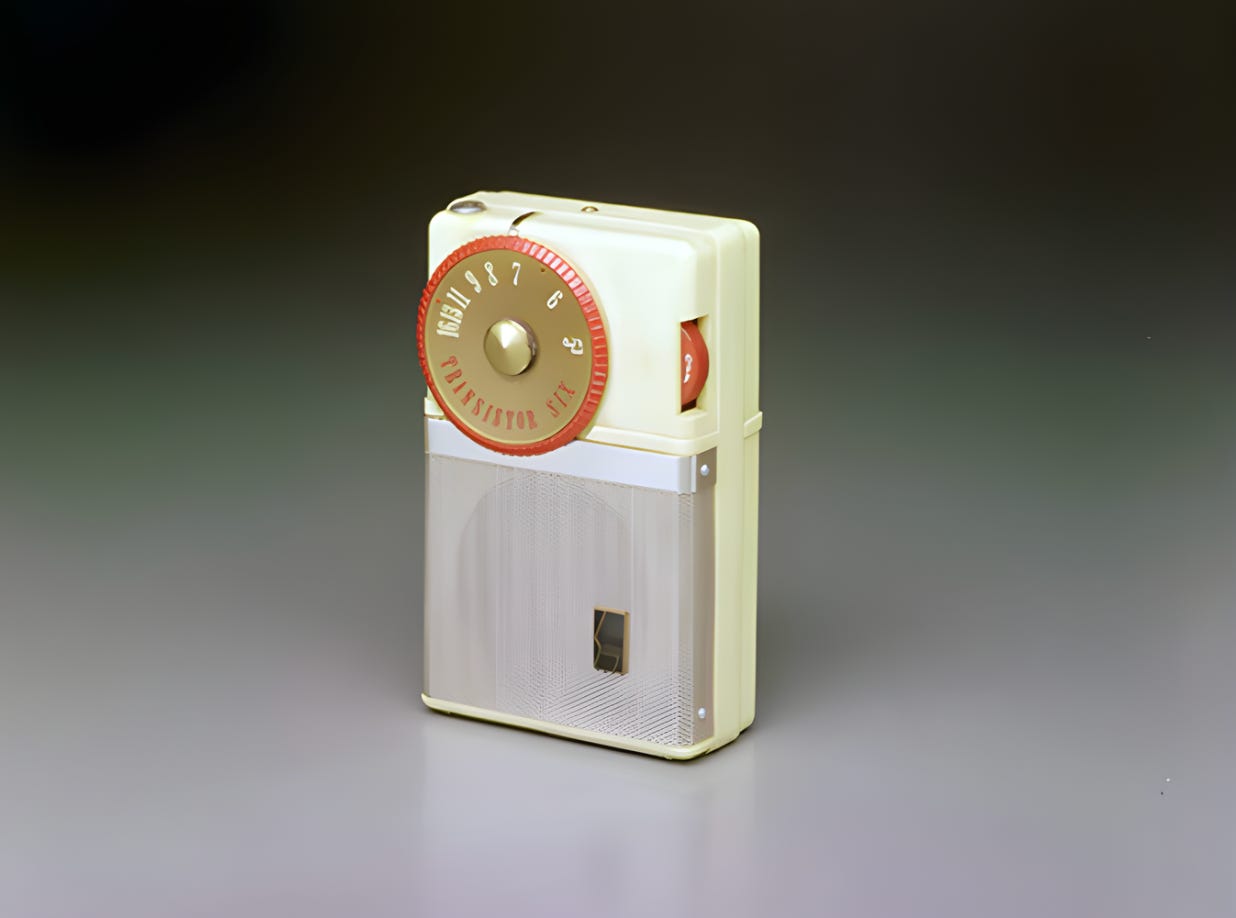
The ‘pocketable’ TR-63
Such was the lingering bitterness towards Japan in various parts of the world, following the recent war, that a name like ‘Tokyo Telecommunications Engineering Company’ was unlikely to generate many sales. It was also long and unwieldy.
So Morita and Ibuka began to cast around for something else. Flicking through a dictionary, they came across sonus – ‘sound’.
It wasn’t bad, but it reminded them of something better: a phrase the GIs used, its bright, fresh associations so attractive that Morita and co. had been applying it to themselves as they worked away in their shack.
They were ‘sonny-boys’, so surely their company was Sonny. Better still, Sony.
Yes, that would do.
—
Thank you for being a paid subscriber to Japan and the World! Feel free to share this post with someone interested in postwar Japan or the history of modern technology.
My father went on business trip to Japan around 1967 and brought back two bright red Sony pocket radios for my brother and I (we were 8 and 9). We were completely excited.