


Last chance to book for my upcoming Zoom talk on ‘How to Read Japanese Art.’ It takes place on Wednesday 18th November, and newsletter subscribers get a discount:
How to Read Japanese Art: A Beginner’s Guide
Details HERE
Booking HERE
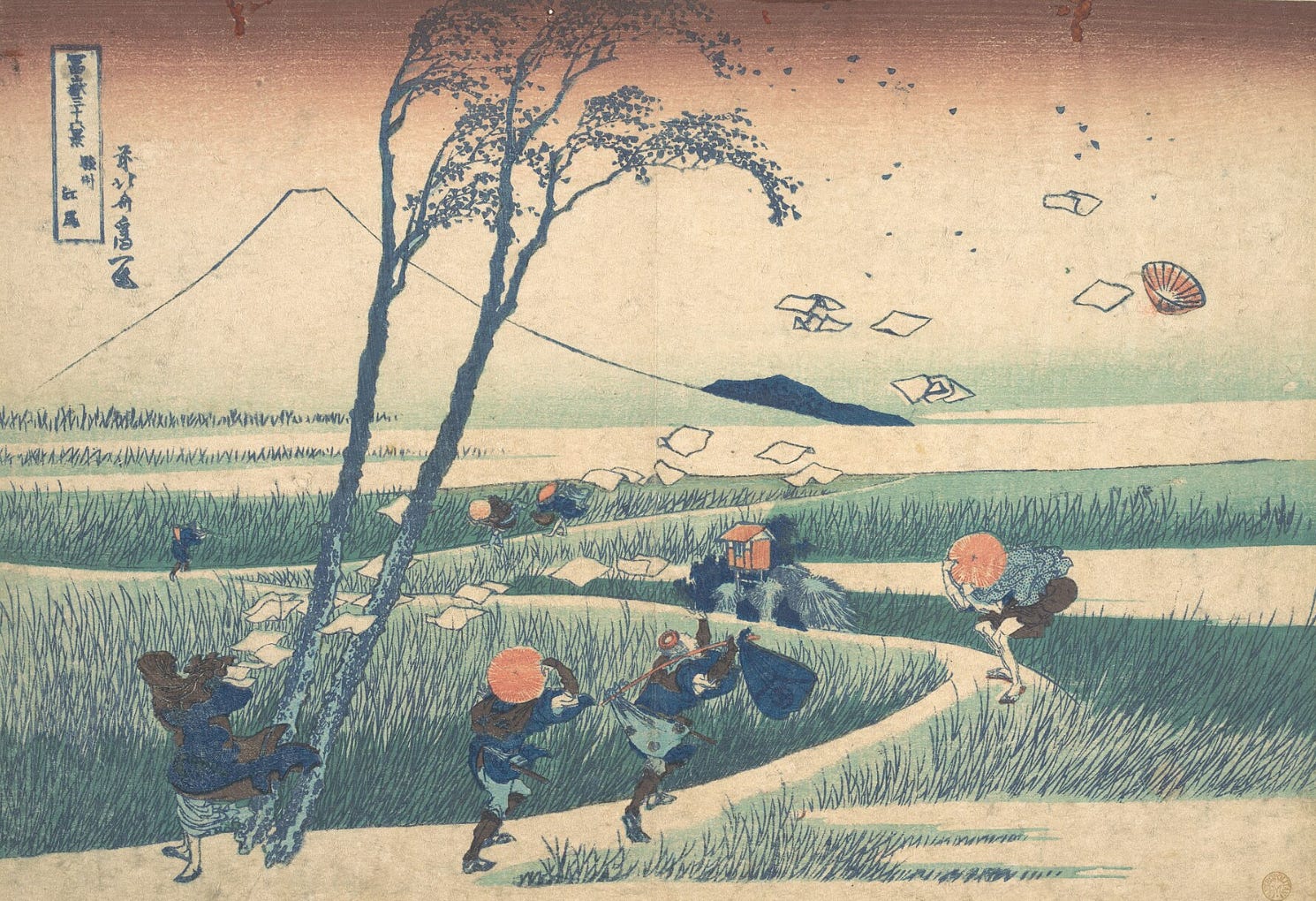
I hope to see you there!
It’s not often that my favourite part of a woodblock print is the censors’ seal.
But have a look at this:
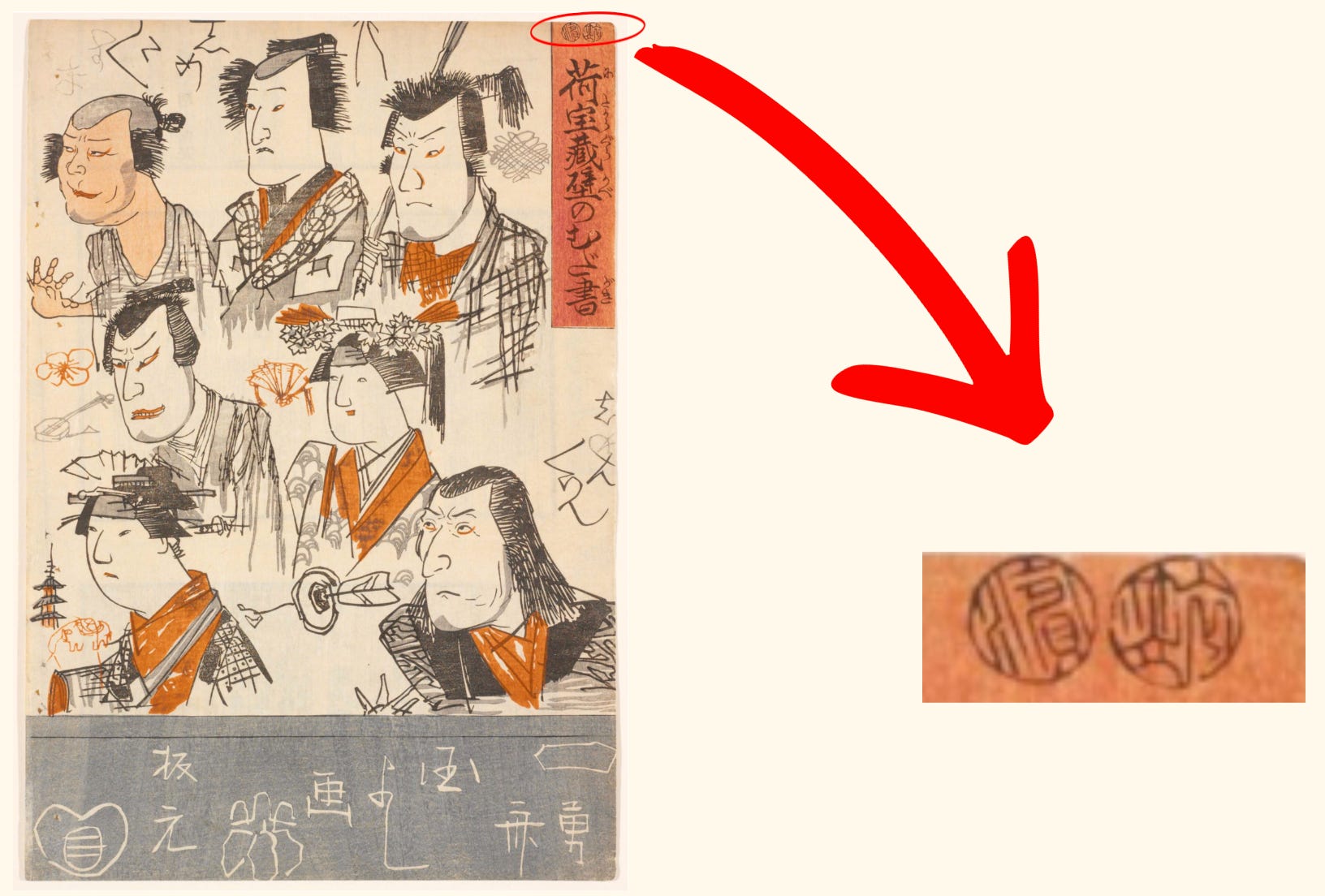
This is ‘Scribblings on the Storehouse Wall’ (c. 1847) by Utagawa Kuniyoshi. And these two seals tell us that not one but two Edo censors have approved a work of art that is mocking them and their line of work.
Edo Japan (1603 - 1868) was, in theory at least, a tightly-controlled society. From samurai down to outcastes, everyone was expected to know their place and live accordingly. The chances, for most people, of changing jobs, moving village or travelling for pleasure were low. Nor did people have the freedom to speak and behave as they wished.
Much of the Edo energy that we all appreciate in the twenty-first century - from kabuki to woodblock prints - came from this ethic of social control bumping up against people’s desire to live, love and be entertained.
Kuniyoshi understood this as well as anyone. So when the authorities clamped down on artistic representations of celebrated kabuki actors - kabuki being a feared source of potential disorder - Kuniyoshi devised a cunning plan.
He produced a woodblock print featuring some of the best-known actors, then passed it off as mere reporting. This was just graffiti, he claimed, which he had encountered on the wall of a storehouse. So he wasn’t actually breaking the law…
If this struck the censors as being a vexatiously unsubtle attempt at breaking the rules, then Kuniyoshi’s second wheeze, in 1847, might well have tipped them over the edge. Famous kabuki actors - depicted as cats:
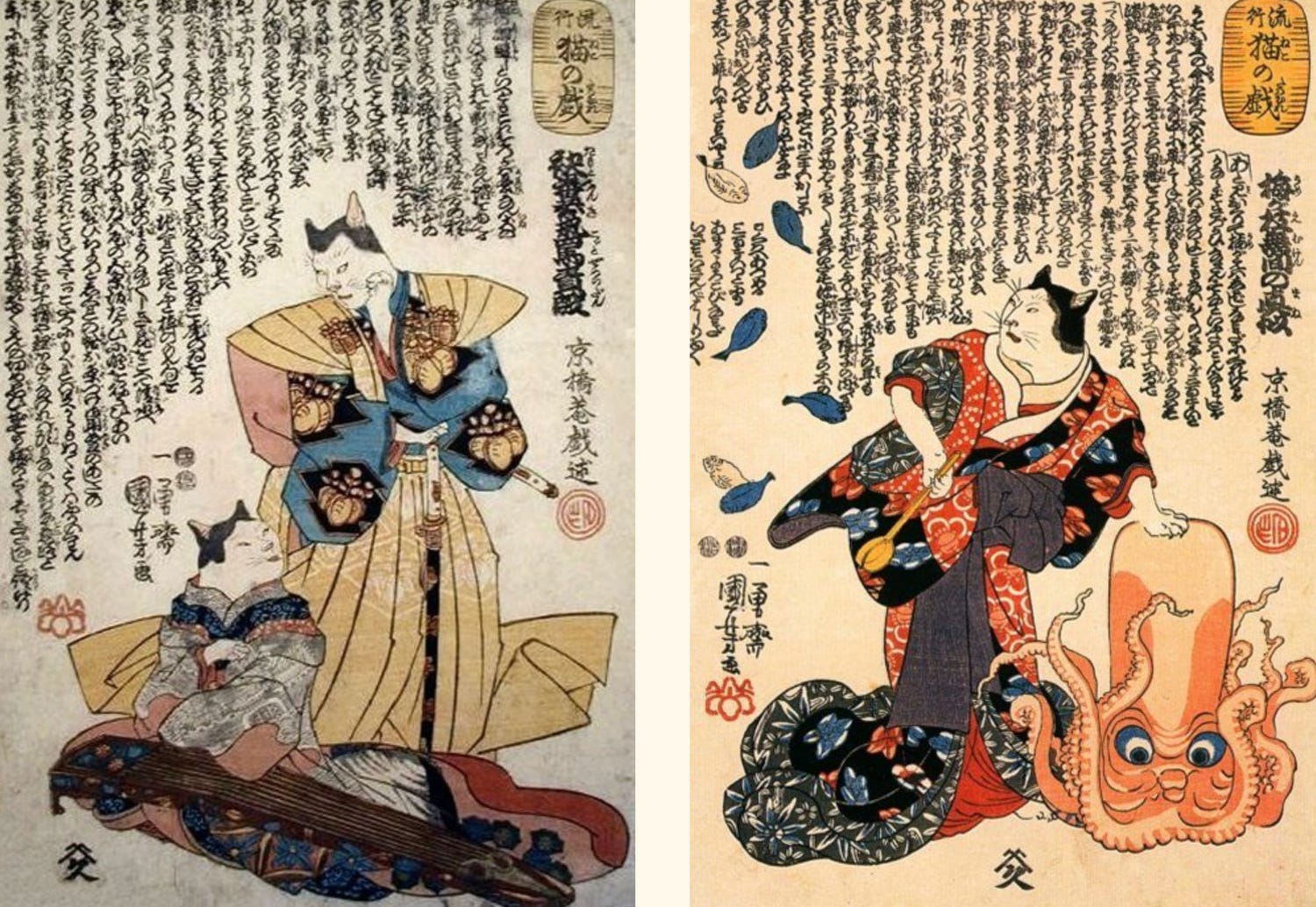
Was Kuniyoshi worried about doing prison time?
Perhaps a little. But actually what these prints tell us is that censorship in Edo Japan was - by the late 1840s at least - weakening.
A senior shogunal councillor had already started complaining that local authorities in parts of Edo were becoming slack in policing things like kabuki actor likenesses, the production of erotic prints, women’s hairstyles, and gambling.
Kuniyoshi and his publisher perhaps sensed a sweet spot. Prints like these, effectively lampooning the authorities, were unlikely to be punished - especially once censors had approved the preliminary drawings. But they might yet strike customers as daring. And that could only be good for business.
Woodblock prints are a great way of tracing not just shifting attitudes towards government censorship, but also one of the shogunate’s great obsessions: luxury.
All the way back to Tokugawa Ieyasu himself, early modern shoguns had defined a well-lived life in terms of purpose and frugality. To indulge in luxury was both a personal moral failing and a frittering away of the country’s resources.
Prints were hardly a luxury, of course. You could pick one up for the price of a couple of bowls of noodles. But Edo Japan was full of entrepreneurs, one of whom was the publisher Tsutaya Jūzaburō. He put powdered mica in some of his woodblock prints - a technique known as kirazuri - and worked with the artist Utamaro in the 1780s and 1790s to produce portraits of beautiful women that would shimmer when you changed your angle of view.
These prints of women - unattainable objects of desire turned into thoroughly attainable objects of desire - quickly caught the attention of the authorities. Publishers were warned against extravagance, and Tsutaya seems to have taken a short break from using mica. But he returned to it a year or two later, with a new set of prints by an artist called Sharaku, this time featuring kabuki actors. Once again, the production of these glittering works of art did not last long. Some critics think that the shogunate must have stepped in for a second time and banned the use of mica.
Lucky for us that Tsutaya was prepared to take risks:
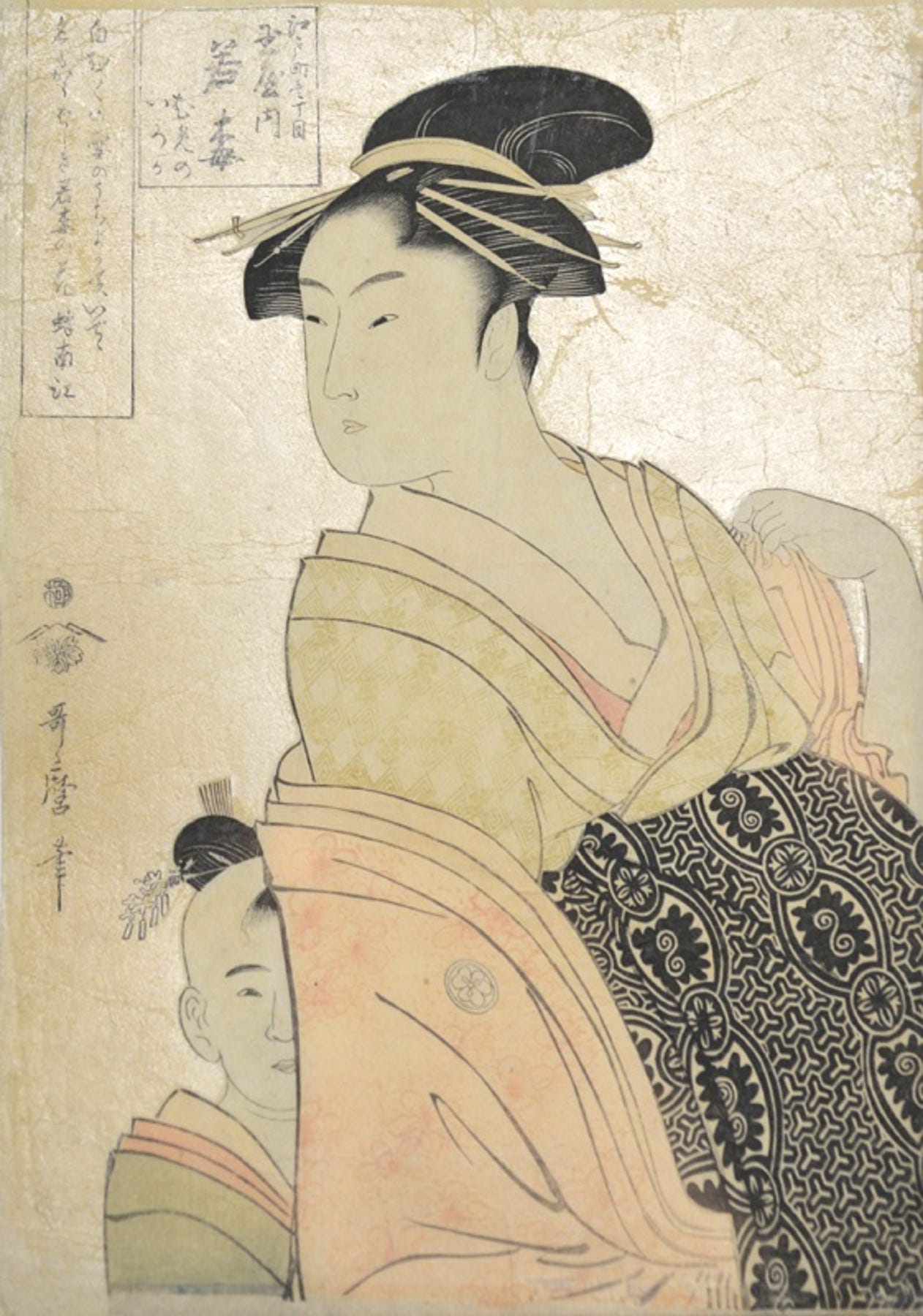
Kitagawa Utamaro, ‘Courtesan Wakaume From the Tamaya’ (1793-4)
An important rule about censorship - which every artist understood - was that you couldn’t go after individuals but you could lampoon types of people, alongside (most) regulations.
Enter, at this point, Katsushika Hokusai: one of the two greatest landscape artists of 19th-century Japan, alongside Hiroshige, but also a gifted satirist.
In the mid-1830s, Hokusai aimed some of his satirical fire at a segment of society which many of his commoner customers would have had cause by this point to disparage and even actively to dislike:
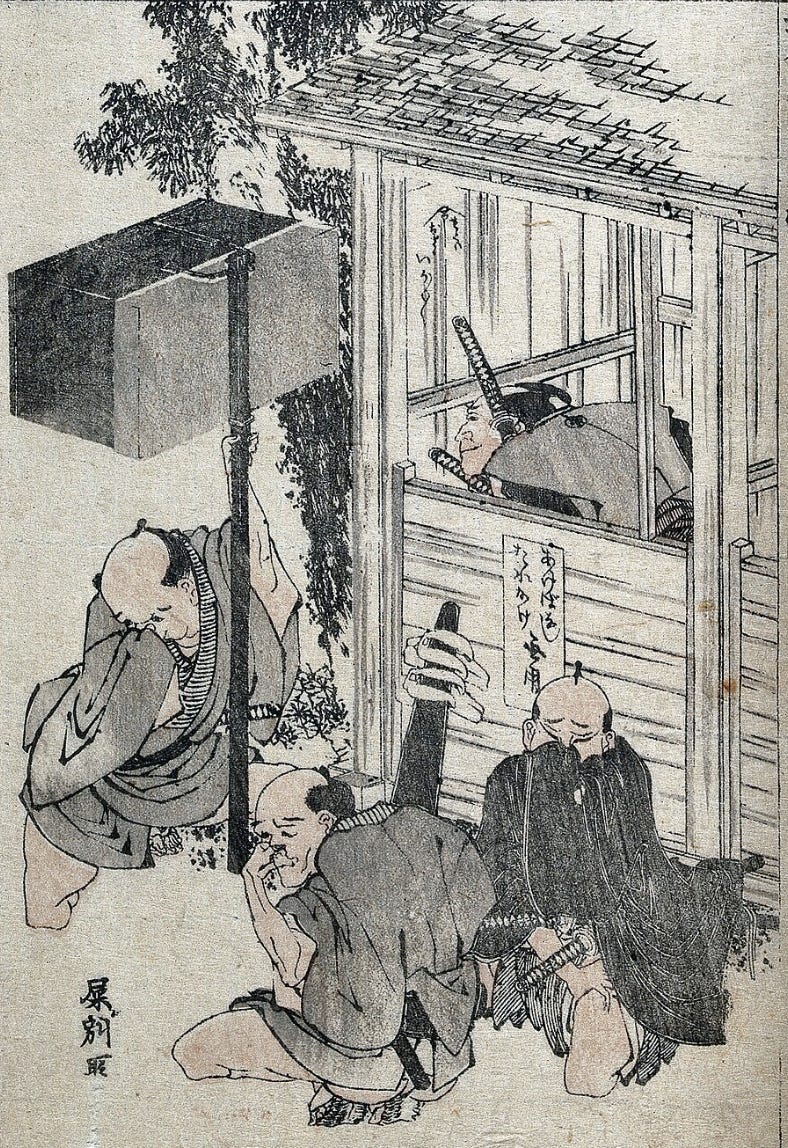
Katsushika Hokusai, ‘Servants hold their noses while their master uses the latrine’ (1834)
By the time that Hokusai made this image, many in Japan were questioning the elevated role still enjoyed by samurai in Japanese society. The great swashbuckling wars of the Sengoku era were long in the past, and samurai armour was a display item rather than something ready to be donned in a hurry should the need arise.
Too many samurai had developed a reputation for shopping and bad poetry, while ordinary people - including Hokusai’s client base - were subsidising their lifestyles via heavy taxation.
This whole situation, Hokusai seems to suggest, stinks. And though it stinks, such is the way of things that all most of us can do is crouch on the ground and hold our noses.
Hokusai didn’t live to see it, but the system that he’s laughing at here had little more than 30 years to run at this point. What did for the shogunate in the end was the arrival of Western powers on Japan’s doorstep in the 1850s, and the crisis it inspired. But the fact that so few in Japan appear to have mourned the passing of the shoguns and of samurai rule perhaps owes a little something to the courage and humour of the era’s artists.
Come and hear more about Japanese prints, scrolls and screens at my Zoom talk on Wednesday 18th November: How to Read Japanese Art: A Beginner’s Guide. Details HERE & booking HERE.
—
Images
Utagawa Kuniyoshi, ‘Scribblings on the Storehouse Wall’ (c. 1847): Pulitzer Arts (fair use).
Utagawa Kuniyoshi, ‘Fashionable Cat Frolics (1847)’: Kuniyoshi Project (fair use).
Kitagawa Utamaro, ‘Courtesan Wakaume From the Tamaya’ (1793-4): Ronin Gallery (fair use).
Katsushika Hokusai, ‘Servants hold their noses while their master uses the latrine’ (1834): Wikimedia (public domain).
